Exploring Cells: Origins, Structures, and Functions
360 likes | 376 Vues
Delve into the fascinating world of cells - from cork discovery to Cell Theory, Prokaryotes to Eukaryotes, and organelles like Nucleus, Mitochondria, and more. Learn how cells' sizes, features, and functions differ, in both plants and animals.


Exploring Cells: Origins, Structures, and Functions
E N D
Presentation Transcript
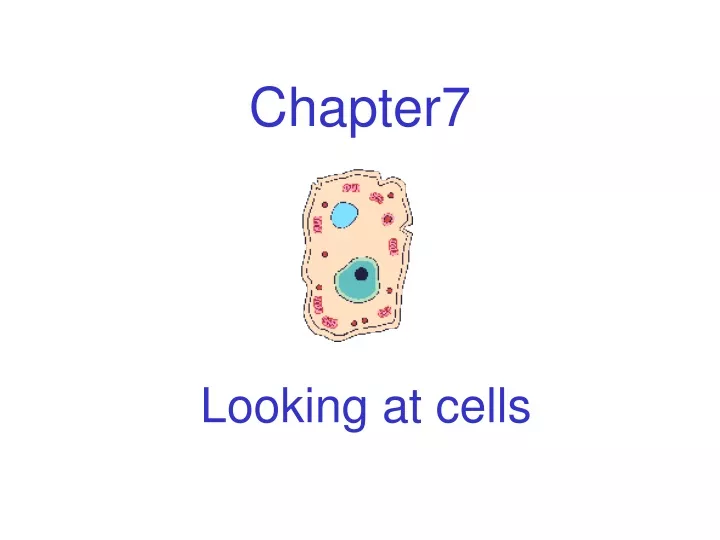
Chapter7 Looking at cells
Where does cork come from? • The bark of an oak tree that grows in Spain and Portugal • The bark is dead • All that is left are the cell walls enclosing air
Microscopes reveal cell structure • Robert Hooke , an English scientist, invented the microscope in the 1600’s to view cork • He named the “little boxes” he saw, “cells”
Anton van Leeuwenhoek • 10 years after Hooke’s findings • Used a microscope to view pond water • He named the single-celled organisms he discovered “animalcules”
The Cell Theory • All living things are made of cells • Cells are the basic units of structure and function in organisms • All cells arise from existing cells
Measuring the size of cell structures • Measurements are in metric units • International System of Measurements (SI) • Based on powers of 10 • Micrometers are one-millionth of a meter ( the size of a bacterial cell)
Cells must be small • Lower surface area to volume ratio = inability to move substances across the membrane in large enough numbers • Higher surface area to volume ratio = greater ability to exchange substances Small is good! Big is bad!
Common features of all cells • Cell membrane • Cytoplasm • Cytoskeleton • Ribosomes • Genetic material
Prokaryotes do not contain internal compartments • No nucleus • Smaller • Ex: bacteria
Characteristics of bacteria • Prokaryotes • All have a cell wall surrounding the cell membrane • Some have flagella for movement • DNA is circular instead of linear • Some have a capsule for clinging
Eukaryotic cells are organized • Have a nucleus • Have other membrane enclosed organelles • Some have flagella or cilia for movement
Eukaryotes • Larger • More complex • Many are highly specialized • Plants, animals, fungi, and many protists
Cell Organization • Two divisions: • Nucleus- eukaryotes only • Cytoplasm- fluid portion of the cell outside the nucleus • Eukaryotes and prokaryotes
Organelles • Specialized structures • “Little organs”
Nucleus • Controls cell functions • Surrounded by a double membrane with nuclear pores • Contains DNA wound around proteins • Wind up into chromosomes before division takes place
Nucleus • Nucleolus- where ribosomes are made • Nuclear pores- allow materials in and out
Vacuoles • Large, saclike, membrane-enclosed structures that store materials such as water, salts, proteins, and carbohydrates
Vacuoles • Plants- large central vacuole, helps keep leaves and flowers rigid • Found in some unicellular organisms and animals • Contractile vacuole in paramecium
Vesicles • In almost all eukaryotic cells • Used for storage and movement
Lysosomes • Small organelle filled with enzymes • Digest old organelles, cellular “junk,” lipids, proteins, and carbohydrates • Type of vesicle, found in animal and some plant cells
Ribosomes • Made of RNA and protein • Produce proteins • Found in the cytoplasm (free) and rough ER (attached)
Endoplasmic Reticulum (ER) • A system of internal membranes that moves proteins and other substances through the cell • Rough ER- has ribosomes on the surface that create exported proteins • Smooth ER- no ribosomes, makes lipids for the cell membrane • Detoxifies drugs
Golgi Apparatus • Stack of flattened sacs • Modifies, sorts, and packages proteins made from the rough ER • Sent into or out of the cell
Sources of Energy • Mitochondria- animal and plant cells • Chloroplasts- plant cells
Chloroplasts • Converts sunlight into food energy in a process called photosynthesis • Double membrane • Contains a green pigment called chlorophyll
Mitochondria • In eukaryotic cells • Power plant of the cells • Converts food energy into smaller units the cell can more easily use • Double membrane
Mitochondria • Inherited only from your mother • A way to trace the maternal lines of animals
Endosymbiotic Theory • Chloroplasts and mitochondria have their own DNA and double membranes • Theory states: • These may have been independent organisms at one time • Create their own energy • May have been beneficial once absorbed and found to be beneficial
Unique features of plant cells • Cell wall -surrounds the cell membrane, supports and protects the cell • Chloroplasts- green structures that absorb sunlight and produce glucose • Central vacuole- stores water and other substances, when full makes a cell rigid
Cytoskeleton • Network of protein filaments • Gives cells their shape and internal organization • Helps to transport materials inside the cell • Protein filaments • Microtubules • Microfilaments
Microfilaments • Threadlike structures made of protein called actin • Make up a tough flexible framework that helps support the cell • Help cells move • Amoebas- assemble and disassemble to help them move
Microtubules • Hollow structures • Made of protein tubulin • Maintains cell shape • Centrioles • Makes spindle during mitosis to separate chromosomes
Microtubules • Make up cilia and flagella • Used for swimming • Arranged in a 9+2 pattern • Small bridges between aid in movement
Cell Boundries • Cell wall • Cell membrane
Cell Wall • Prokaryotes, plants, algae, fungi • Animal cells do not • Outside the cell membrane • Strong supporting layer • Porous- allows water, carbon dioxide and oxygen to pass through
Cell Membrane • Protects and supports cell • Regulates what enters and leaves • Phospholipid bilayer- to layers of lipids