Download
1 / 19
210 likes | 367 Vues
Community Emergency Response Teams (CERT) play a crucial role in enhancing fire safety preparedness. They are trained to tackle small fires, prevent their spread, shut off utilities, and assist with evacuations when necessary. This program aims to educate participants on the essential functions of CERTs in identifying potential fire risks in the workplace, conducting basic fire size-ups, understanding fire chemistry, and employing safety precautions with hazardous materials. By honing these skills, CERT members can effectively mitigate fire hazards and respond confidently to emergencies.

E N D
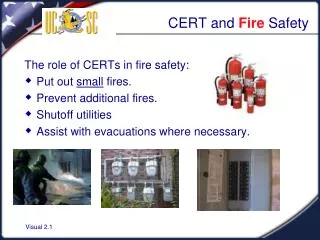
CERT and Fire Safety The role of CERTs in fire safety: • Put out small fires. • Prevent additional fires. • Shutoff utilities • Assist with evacuations where necessary.
Unit Objectives • Explain the role of CERTs in fire safety. • Identify and reduce potential fire risks in the workplace. • Conduct a basic sizeup for a fire emergency. • Understand basic safety precautions. • Identify hazardous materials in the workplace. • Extinguish small fires using a fire extinguisher.
The Fire Triangle • Heat • Fuel • Oxygen
Fire Chemistry Classes of fire: • A: Ordinary combustibles • B: Flammable and combustible liquids • C: Energized electrical equipment • D: Combustible metals
Reducing Fire Hazards-Electrical • Avoid the “electrical octopus.” • Don’t run cords under carpets. (First fire UCSC) • Replace broken or frayed cords. • Maintain appliances and workplace electronics.
Reducing Fire Hazards-Gas • Install a natural gas detector. • Locate and label gas shutoffs.
Reducing Fire Hazards-Flammable liquids • Read labels. • Use L.I.E.S. storage procedures (Limit, Isolate, Eliminate, Separate).
CERT Fire Size-up Answer these questions: • Can my buddy and I fight the fire safely? • Do we have the right equipment? • Are there other hazards? • Is the building structurally damaged? • Can we escape?
CERT Sizeup • Gather Facts. • Assess Damage. • Consider Probabilities. • Assess Your Situation. • Establish Priorities. • Make Decisions. • Develop Plans of Action . • Take Action. • Evaluate Progress.
Firefighting Resources Resources available: • Portable fire extinguishers • Wet standpipes • Confinement • “Creative” resources
Types of Fire Extinguishers • Water • Dry chemical • Carbon dioxide • Specialized fire extinguisher
P.A.S.S • Pull • Aim • Squeeze • Sweep Test the extinguisher before approaching any fire.
Fire Suppression Safety Do: • Use safety equipment. • Work in a buddy system. • Have a backup team. • Have two ways to exit. • Maintain a safe distance. • Overhaul the fire.
Fire Suppression Safety DON’T • Try to suppress large fires. • Get too close. • Fight it alone. • Enter smoke-filled areas.
Hazardous Materials • Corrode other materials • Explode or are easily ignited • React strongly with water • Are unstable when exposed to heat or shock • Are toxic to humans, animals, or the environment
Identifying Stored Hazardous Materials NFPA 704 Diamond-White Quadrant: W Shows unusual reactivity with water OX Possesses oxidizing properties
Red & Orange Red White Red White White Blue Yellow Black & Red & Yellow & White White White Identifying Hazardous Materials in Transit
Symbol Chemical Number Chemical Class Identifying Hazardous Materials in Transit Symbol Name Chemical Class