SlideServe
Menu
Préférences
© SlideServe · v2026

Main Research Objectives

briar avatar
1 diapositives · 190 Views · Sep 12, 2014

Decision Making in Smart-Grids Supporting OPF & Renewable Energy Standards: A Bi-Level Multi-Period Formulation Ahmad F. Taha 1 and Jitesh H. Panchal 2 1 Ph.D. Student , School of Electrical and Computer Engineering, Purdue University
Main Research Objectives - slide 1
01 / 1Main Research Objectives
1 / 17

Télécharger la présentation

Main Research Objectives
Une image / un lien ci-dessous est fourni (tel quel) pour télécharger la présentation

Politique de téléchargement : le contenu du site vous est fourni TEL QUEL pour votre information et votre usage personnel ; il ne peut être vendu, concédé sous licence ni partagé sur d’autres sites sans l’accord de son auteur.Le contenu vous est fourni TEL QUEL, pour votre information et votre usage personnel uniquement. Téléchargez la présentation en cliquant sur ce lien. Lors du téléchargement, si vous ne parvenez pas à télécharger une présentation, l’éditeur a peut-être supprimé le fichier de son serveur.Pendant le téléchargement, si vous ne parvenez pas à obtenir une présentation, le fichier a peut-être été supprimé par l’éditeur.

F I N

Plus de contenu associé

Transcription de la présentation
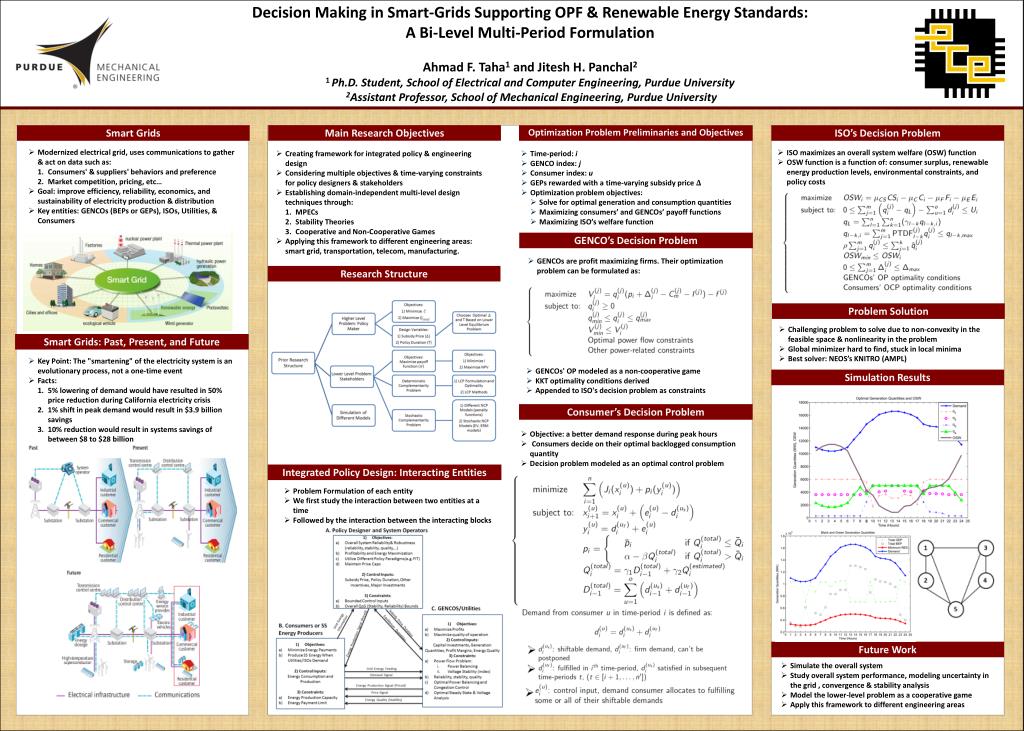
  1. Decision Making in Smart-Grids Supporting OPF & Renewable Energy Standards: A Bi-Level Multi-Period Formulation Ahmad F. Taha1 and Jitesh H. Panchal2 1 Ph.D. Student, School of Electrical and Computer Engineering, Purdue University 2Assistant Professor, School of Mechanical Engineering, Purdue University Main Research Objectives Smart Grids Optimization Problem Preliminaries and Objectives ISO’s Decision Problem • Modernized electrical grid, uses communications to gather & act on data such as: • Consumers' & suppliers' behaviors and preference • Market competition, pricing, etc… • Goal: improve efficiency, reliability, economics, and sustainability of electricity production & distribution • Key entities: GENCOs (BEPs or GEPs), ISOs, Utilities, & Consumers • ISO maximizes an overall system welfare (OSW) function • OSW function is a function of: consumer surplus, renewable energy production levels, environmental constraints, and policy costs • Creating framework for integrated policy & engineering design • Considering multiple objectives & time-varying constraints for policy designers & stakeholders • Establishing domain-independent multi-level design techniques through: • MPECs • Stability Theories • Cooperative and Non-Cooperative Games • Applying this framework to different engineering areas: smart grid, transportation, telecom, manufacturing. • Time-period: i • GENCO index: j • Consumer index: u • GEPs rewarded with a time-varying subsidy price • Optimization problem objectives: • Solve for optimal generation and consumption quantities • Maximizing consumers’ and GENCOs’ payoff functions • Maximizing ISO’s welfare function GENCO’s Decision Problem • GENCOs are profit maximizing firms. Their optimization problem can be formulated as: Research Structure Problem Solution • Challenging problem to solve due to non-convexity in the feasible space & nonlinearity in the problem • Global minimizer hard to find, stuck in local minima • Best solver: NEOS’s KNITRO (AMPL) Smart Grids: Past, Present, and Future • Key Point: The "smartening" of the electricity system is an evolutionary process, not a one-time event • Facts: • 5% lowering of demand would have resulted in 50% price reduction during California electricity crisis • 1% shift in peak demand would result in $3.9 billion savings • 10% reduction would result in systems savings of between $8 to $28 billion • GENCOs' OP modeled as a non-cooperative game • KKT optimality conditions derived • Appended to ISO's decision problem as constraints Simulation Results Consumer’s Decision Problem • Objective: a better demand response during peak hours • Consumers decide on their optimal backlogged consumption quantity • Decision problem modeled as an optimal control problem Integrated Policy Design: Interacting Entities • Problem Formulation of each entity • We first study the interaction between two entities at a time • Followed by the interaction between the interacting blocks Future Work • Simulate the overall system • Study overall system performance, modeling uncertainty in the grid , convergence & stability analysis • Model the lower-level problem as a cooperative game • Apply this framework to different engineering areas