Download
1 / 32
320 likes | 468 Vues
This document explores the effects of recombination in a test cross, specifically between two strains, AABB and aabb. Key concepts covered include non-recombinant and recombinant phenotypes as well as the rate of recombination, which varies with gene distance on a chromosome. The analysis utilizes a two-point and three-point mapping approach to estimate rates of recombination and map distances among multiple gene loci. The significance of double crossovers, the importance of progeny phenotype diversity, and methods of gene mapping are also discussed, providing insights into genetic linkage.

E N D
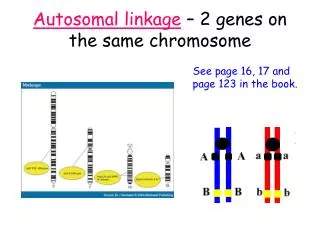
Effects of Recombination in a Test Cross P: AABB x aabb F1: AaBb Test Cross: AaBb x aabb Non-recombinants phenotypes: A-B- and aabb Recombinant phenotypes: A-bb and aaB-
Rate of recombination The further apart two genes are on a chromosome, the more likely recombination will separate them r = proportion of recombinant offspring in testcross r ranges from 0 (no recombination) to 0.5 (half recombinants).
Rate of recombination with a 2-point test cross P AABB x aabb ABab ABab F1 AaBb AB ab Test Cross: AaBb x aabb Non-recombinant gametes: ab, AB Recombinant gametes: Ab, aB Each type of gametes will correspond to a different phenotype in the progeny
Genetic Mapping with Recombination • Genes that are far apart on a chromosome are more likely to be recombined • Rate of recombination increases with distance • If crossing-over occurs on one sister chromatid, it doesn’t occur on the other • Rate of recombination is never above 0.5 • 1 map unit = 1% recombination • map distance = r x 100
A Mapping Example • Three gene loci: E, F and G • Order of genes on chromosome unknown • Observed rates of recombination are: r(E/F) = 0.05, map distance = 5 r(E/G) = 0.10, map distance = 10 r(F/G) = 0.15, map distance = 15 Step 1: The greatest map distance must be between ends of map F and G are the ends Step 2: Put the third locus between them, spaced according to map distances F –– E ––––– G 5 10
Double Cross-Overs • Double cross-overs have lower probabilities than single cross-overs • Pr(double) Pr(single 1) x Pr(single 2) • Example Pr(double) = 0.2 x 0.1 = 0.02
Three-Point Mapping • Both single and double cross-overs used • All the loci that are being mapped must be heterozygous in one parent • Each possible gamete genotype must correspond to a distinct phenotype in the progeny • A large number of progeny must be counted to obtain accurate estimates
Crosses in which Gamete Genotypes Produce Distinct Phenotypes Test cross: ABC x abc abc x abc Hemizygous males: (X) ABC x (X)abc (X) abc x (Y)
Interpreting 3-Point Crosses • Nonrecombinant gametes are the most common • reveals the combination of alleles on the parental chromosome • Double recombinants are the least common • reveals which of the three genes is “in the middle” • Both single and double cross-overs count as cross-overs between particular pairs of genes • Map distances calculated by counting all crossovers between pairs of gene
Example from Textbook • Three gene loci with recessive mutant alleles in Drosophila: b Black body pr purple eyes c curved wings • Wild type alleles indicated by + • P generation: • one fly b b pr pr c c (all homozygous recessive mutants) • other fly b+ b+ pr+ pr+ c+ c+ (all homozygous dominant wild-type)
Test cross with homozygous recessive for all three loci In progeny of testcross: Non-recombinants: either all dominant or all recessive traits Recombinants: mixture of dominant and recessive traits
Reciprocal Classes • Progeny classes are reciprocal if between them they contain each mutant phenotype just once. Examples: • all wild type and black, purple, curved • purple, curved and black • black and purple, curved
Reciprocal classes are products of the same type of meiotic event Non-recombinants all wild type black, purple, curved Crossover between b and pr loci purple, curved and black
Double crossovers tell you which gene is in the middle b + c + pr +
Crossovers between b and pr include both single crossovers and double crossovers 5.0 % + 0.9% = 5.9% total
Crossovers between pr and c include both single crossovers and double crossovers 18.6 % + 0.9% = 19.5% total