
SlideServe
Menu
Préférences
© SlideServe · v2026

Winter Wandering: Foraging Efficiency Decision for Daisy

buckminster-prince avatar
8 diapositives · 194 Views · Nov 21, 2014

Daisy, a deer in a snowy winter, decides between familiar patch and new forest for food in snow. Calculations show foraging efficiency - decide where she should go.
Winter Wandering: Foraging Efficiency Decision for Daisy - slide 1
01 / 8Winter Wandering: Foraging Efficiency Decision for Daisy
1 / 17

Télécharger la présentation

Winter Wandering: Foraging Efficiency Decision for Daisy
Une image / un lien ci-dessous est fourni (tel quel) pour télécharger la présentation

Politique de téléchargement : le contenu du site vous est fourni TEL QUEL pour votre information et votre usage personnel ; il ne peut être vendu, concédé sous licence ni partagé sur d’autres sites sans l’accord de son auteur.Le contenu vous est fourni TEL QUEL, pour votre information et votre usage personnel uniquement. Téléchargez la présentation en cliquant sur ce lien. Lors du téléchargement, si vous ne parvenez pas à télécharger une présentation, l’éditeur a peut-être supprimé le fichier de son serveur.Pendant le téléchargement, si vous ne parvenez pas à obtenir une présentation, le fichier a peut-être été supprimé par l’éditeur.

F I N

Plus de contenu associé

Transcription de la présentation
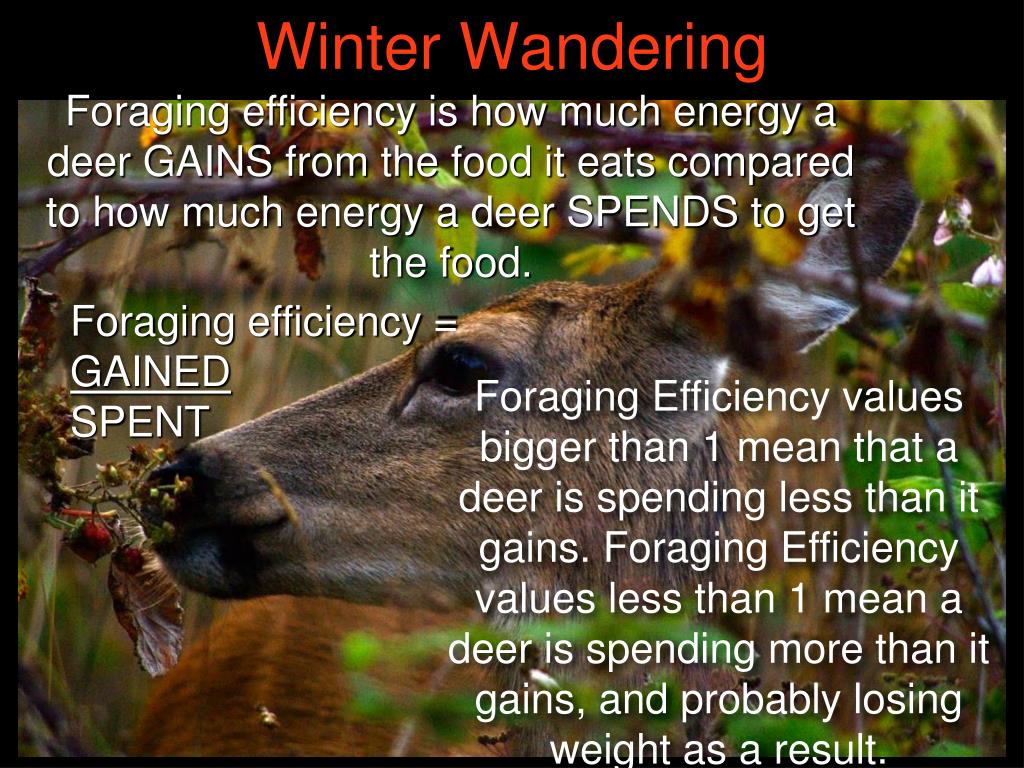
  1. Foraging efficiency is how much energy a deer GAINS from the food it eats compared to how much energy a deer SPENDS to get the food. • Foraging efficiency = GAINED SPENT Foraging Efficiency values bigger than 1 mean that a deer is spending less than it gains. Foraging Efficiency values less than 1 mean a deer is spending more than it gains, and probably losing weight as a result. Winter Wandering

  2. It’s winter, and food is hard to come by. What’s more, it’s snowy! Daisy needs to decide if she should stay in her home patch of forest, or if she should cross the snowy meadow to a new patch of forest with fresh shrubs to eat. Help Daisy decide where to go:

  3. Here are the numbers: + Energy spent + If Daisy stays in her patch of forest, she burns 3.5 J/min, and this is the same as in the new patch of forest. But to get to the new patch of forest, she needs to cross 300 meters of knee-deep snow. This costs her 4 times as much energy as usual per minute, and it takes her 30 min to cross the meadow. • + Energy Gains + • If Daisy stays in the first patch of forest, where she’s eaten most of the food, she can eat enough food to gain 2.0 Jewels/minute for the next day (24 hours). • If she gets to the new patch of forest, she can eat enough food to gain 3.0 J/min for the next day.

  4. What should Daisy do? • Go back and carefully read he information, then use the concept of FORAGING EFFICIENCY (gain/spent), calculated for the next 24 hours, to help Daisy decide what to do.

  5. Here are the steps: • 1) Calculate energy GAINS for the old versus new forest patches: • Old forest GAIN = 2.0 J/min x 60 min/hour x 24 hour/day = 2,880 J • New forest GAIN= 2.7 J/min x 60 min/hour x 23.5 hour/day*= 3,807 J • * did you see this tricky part? 30 minutes were spent walking to the new patch of forest , so no energy was gained during this time eating.

  6. Here are the steps: • 2) Calculate energy SPENT for the old versus new forest patches: • Old forest SPENT = 3.5 J/min x 60 min/hour x 24 hour/day = 5,040 J • New forest SPENT= 3.5 J/min x 60 min/hour x 23.5 hour/day + (3.5J/min x 4) x 30 min = 4,935 + 420 = 5, 355 J

  7. Here are the steps: • 3) Calculate foraging efficiency (FE) for the old versus new forest patches: • Old forest FE = 2,880 J / 5,040 J = 0.57 • New forest FE = 3,807 J / 5, 335 J = 0.71

  8. Did you notice? No matter what she does, Daisy is LOSING energy each day in the winter. Deer lose weight all winter long, making up the energy they need each day by burning fat stored on on their bodies. Deer also lower their daily metabolic rate, so that they burn less energy than during the summer. Answer: Daisy should move to the new forest patch. Her foraging efficiency is higher... she gets 71% (.71) of her spent energy back from her food this way, better than 57% if she stayed.