Paperwork
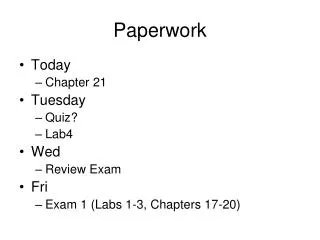
In this week's chemistry schedule, we will cover important chapters and prepare for upcoming assessments. Today, we will focus on Chapter 19, while next week includes guest instructors discussing Chapters 20.1-20.3 on Monday, followed by Lab #2 and Quiz #2 on Tuesday. A review for the exam on thermodynamics is planned following practice problems. Key concepts such as the 1st Law of Thermodynamics, internal energy, and heat transfer will be discussed. Don’t forget to prepare assignments for Chapters 18 and 19, with deadlines approaching!

Paperwork
E N D
Presentation Transcript
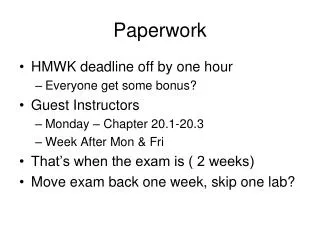
Paperwork • HMWK deadline off by one hour • Everyone get some bonus? • Guest Instructors • Monday – Chapter 20.1-20.3 • Week After Mon & Fri • That’s when the exam is ( 2 weeks) • Move exam back one week, skip one lab?
Schedule Short Term • Today – Chapter 19 • Next Week • Monday –Chapter 20.1-20.3 (Guest) • Tuesday – Lab #2 • Quiz#2 [Chapter 18, Labs] • Wed – Ch. 20.4-20.5 • Friday – Practice Problems • Week After • Monday – Ch. 20.6-20.7 (Guest) • Tuesday – Lab 3 & Quiz 3 • Wed (Was exam) Review 17-20 • Friday 21.1-21.3 (Guest) • Then -
Chapter 19 • 1st Law of Thermo • Q=DU+W (eq. 19.5) • Q = Heat • W = Work • U = Internal Energy [Any Guesses] • Internal Energy • Sum of all KE [Thermo] • Plus Sum of all interactions [bonds] • Not U as in grav. potential energy
Signs & Such • Q=DU+W (eq. 19.5) • Talks about how heat affects a system • What does Q being + mean? • Heat added to system • What happens if DU is positive? • Raise temperature, change state… • Chemical bonds have negative energy • Solid to liquid means DU increases, less neg. • What happens if W is positive? • System does work on its surroundings • Maybe heats up a container, etc…
Signs & Such • Q=DU+W (eq. 19.5) • Talks about how heat affects a system • Q+ heat enters system • DU+ Internal energy raised • Bonds broken, temperature increased • W+ Work done on outside world • W- Work done on system from outside
Isolated System • Q=DU+W • System completely isolated from outside • What is Q? (say as a function of time) • What is W? (time dependence as well) • Implications? • Isolation can be attained by expansion…
Discussion Q18.10Start Gas # molecules = n0 Temperature = T0 pressure = p0 Volume = V0 Vacuum
Discussion Q18.10“Sudden” Hole in wall Gas Initial State # molecules = n0 Temperature = T0 pressure = p0 Volume = V0 Gas Final State # molecules = ? Temperature = ? pressure = ? Volume = ? What Happens here?
Changes in System • Follow equation: Q=DU+W • Look at small changes • dQ = dU + dW • dU = dQ – dW • dW = pdV [gaseous systems] • dU = dQ – pdV [1st law thermo for gas]
Types of Changes • Adiabatic (Constant Heat) • No heat transfer to/from system • Q = 0 • dU = dQ – dW • dU = -dW • As a whole: DU = -W • For a gas: dU = -pdV
Types of Changes • Isochoric (Constant Volume) • No change in volume [Stiff container] • dV = 0 • pdV = 0 = W • dU = dQ • As a whole: DU = Q • For a gas: DU = Q • Usually implies no work done that changes volume • Example: Stirring liquid usually still “isochoric”
Types of Changes • Isobaric (Constant Pressure) • No change in volume [Stiff container] • p = constant • dQ = dU + dW • dQ = dU + pdV • p is constant of integration, no V dependence • Integrate both sides Q = DU + p(DV) • Example: Boiling water in an open pot
Types of Changes • Isothermal (Constant Temperature) • No change in Temp [Could add heat though…] • T = constant • dQ = dU + dW • dQ = dU + pdV • Complicated pV = nRT • p = nRT/V (Ideal Gas) • So integration not trivial even for ideal gas • Example: Icewater mixture, while both exist
Internal Energy of Ideal Gas • Q=DU+W • dQ = dU + dW • Gas: dW = pdV • What does U depend on? • Reminder about U • Measure of internal KE & PE between particles
Discussion Q18.10Start Gas # molecules = n0 Temperature = T0 pressure = p0 Volume = V0 Vacuum
Discussion Q18.10Final State (Again) Q=DU+W Gas Initial State # molecules = n0 Temperature = T0 pressure = p0 Volume = V0 Is there work done on gas? Is there heat input? Gas Final State # molecules = ? Temperature = ? pressure = ? Volume = ? So what is DU?
Internal Energy of Ideal Gas • Q=DU+W • What does U depend on? • Temperature • Gas doesn’t change phase (or its not a gas) • Ideal Gas: No interactions between particles • No potential energy (bonding) between particles • Diatomic molecules?
Ideal Gas Heat Capacities • Different for different conditions • dQ = nCdT [molar heat capacity] • Constant Pressure: CP • Constant Volume: CV • Constant Temperature: CT • Wouldn’t that mean dQ = 0? • Constant n: Cn • n is not in C, other part of Equation
Relationship • CP = CV + R • Derivation in text • Heat capacity larger for isobaric process • Ratio of heat capacities • g = CP/CV = 1.67 (monotomic) • g = CP/CV = 1.4 (diatomic) • g = CP/CV = 1.3 (“triatomic”) • Look at this closer later next week…
Reading & Assignments • Chapter 18 assignment • Up today, Due next Friday • Chapter 19 Assignment • Up today, Due in 1.5 weeks • Put up practice problems • Hopefully answers, etc… • Read chapter 19 & sect. 20.1 to 20.3 for Monday
Schedule Short Term Today – Chapter 19 Next Week Monday –Chapter 20.1-20.3 (Guest) Tuesday – Lab #2 Quiz#2 [Chapter 18, Labs] Wed – Ch. 20.4-20.5 Friday – Practice Problems Week After Monday – Ch. 20.6-20.7 (Guest) Tuesday – Lab 3 & Quiz 3 Wed (Was exam) Review 17-20 Friday 21.1-21.3 (Guest) Then -