Download
1 / 33
330 likes | 449 Vues
This article explores the historical development of the periodic table of elements, starting with J.W. Dobereiner's classification system using triads in 1827. It highlights John Newlands' octaves concept in 1863 and emphasizes Dmitri Mendeleev's pivotal role in creating the modern periodic table, known for his accurate predictions based on atomic arrangements. The piece also touches upon the contributions of Robert Bunsen and Lothar Meyer, providing a comprehensive view of the major milestones in the understanding of elemental classification.

E N D
J.W. Dobereiner first attempted to put together a system for classifying the elements in 1827. He used the idea of the triad.
Dobereiner’sTriads Note: In each case, the numerical values for the atomic mass and density of the middle element are close to the averages of the other two elements
John Newlands – Presented the idea of the octave in chemistry back in 1863. Was laughed out of the building. He was able to have the last laugh, however. He was awarded the Davy Medal in 1887 for his work after Mendeleev’s table was accepted and his ideas acknowledged.
Robert Bunsen “Burner” Lothar Meyer Dmitri Mendeleev
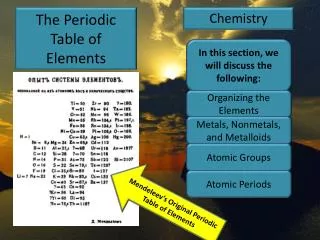
Mendeleev is credited with creating the modern periodic table of the elements. He gets the credit because he not only arranged the atoms, but he made predictions based on his arrangement which were shown to be quite accurate.
Here is another link http://chemlab.pc.maricopa.edu/periodic/giguere.html
Trends Within the PeriodicTable