Central Nervous System
This overview discusses the protective structures of the central nervous system, highlighting the meninges and spinal cord. The meninges consist of three layers: the dura mater (outer), arachnoid mater (middle), and pia mater (inner). The spinal cord, with its 31 segments, is responsible for conducting nerve impulses and serves as a center for spinal reflexes. The overview also explores the nature of reflexes, including inborn and learned reflexes, and the components of a reflex arc, which enables rapid responses to stimuli.


Central Nervous System
E N D
Presentation Transcript
Central Nervous System Ch. 13-1
Protective Structures • Bone • Meninges • Cerebro-spinal fluid
Meninges • Three connective tissue coverings that encircle the spinal cord and brain • Dura mater – most superficial • Arachnoid mater – looks like spider web • Pia mater – thin, transparent, adheres to surface of brain and spinal cord
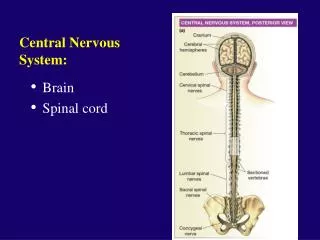
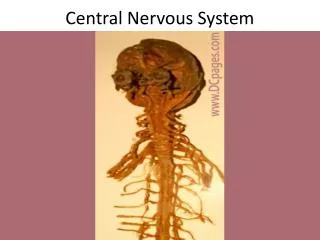
Spinal Cord • Has 31 segments, each with a pair of spinal nerves • 2 main enlargements • Cervical – supplies nerves to upper limbs • Lumbar – supplies nerves to lower limbs • Function • Conducting nerve impulses • Serves as a center for spinal reflexes
Spinal Cord • Ascending – impulses travel to the brain (sensory) • Descending – impulses travel to the muscles (motor)
Reflexes • Fast, automatic, unplanned sequence of actions that occurs in response to a particular stimulus • Some are inborn • Moving hand from hot surface • Some are learned or acquired • Slamming on breaks while driving
Reflexes • Spinal reflex • Integration occurs in spinal cord • Knee-jerk reflex • Cranial reflex • Integration occurs in brain stem • Tracking movements of the eyes while reading • Somatic reflex • Involve contraction of skeletal muscles • Autonomic reflex • Not consciously perceived
Reflex Arc • Pathway followed by a nerve impulse that produces a reflex • 5 components • Sensory receptor • Sensory neuron • Integrating center • Motor neuron • Effector