Download
1 / 9
90 likes | 213 Vues
This document discusses critical strategies for developing effective electronic waste (e-waste) collection programs, as highlighted in the EPA Capacity Building Workshop held in Tijuana, Mexico, on December 4-6, 2007. Key points include the need for convenient collection locations and times, affordable options, and consumer incentives to boost participation. The discussion encompasses rural, suburban, and urban settings, emphasizing diverse programs for various consumer needs. It also addresses business collection challenges, costs, and trends in e-waste management solutions.

E N D
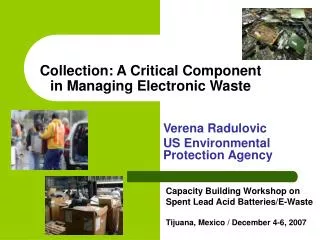
Collection: A Critical Component in Managing Electronic Waste Verena Radulovic US Environmental Protection Agency Capacity Building Workshop on Spent Lead Acid Batteries/E-Waste Tijuana, Mexico / December 4-6, 2007
Goal: In developing collection programs: Make recycling your electronics as easy as it is to buy them
Issues in Collection: How to get consumers to participate? • Need to be predictable- both in location and collection times. • Make recycling options convenient. But what is the definition of convenient? • Need to think about what would be effective for where citizens are located: Rural, suburban or urban settings. Is it located in commonly visited routes or locations? • Different kinds of programs for different consumers: ongoing collection sites, one-day recycling events retailer takeback, mailback programs. Variety of programs to meet local needs may be necessary.
Issues in Collection: How to get consumers to participate? • Make collection low cost/ affordable • May need consumer incentives (manufacturer or retailer coupons, rebates, etc.) • Increase Consumer Awareness on existing infrastructure for collecting electronics. • Different infrastructure for different products-cell phones, TVs, computers. • Communicate why it is important to recycle electronics (social and environmental benefits).
Issues in Collection: Business is different • Small businesses: need pick up from recycler or drop off at municipal collections. • Larger businesses: need pick-up from recyclers. • Reverse Logistics opportunities in deliveries. • Uncertainty in choosing safe, environmentally-friendly electronics recyclers. • Incentives for recycling: • Hazardous waste management requirements and landfill bans can spur recycling. Though legislation usually does not direct collection systems. • Storage Costs. * Recycling or Reusing used electronics can be incorporated into lease agreements/contracts
Issues in Collection: Costs • Cost- labor and transportation in collection programs can be expensive. How can collection systems become more efficient? (collecting in bulk? using reverse logistics? Anticipating a predicable stream) • Televisions (and old CRT monitors) are usually more costly to manage and recycle than computers, which are more profitable. • Administrative costs depend on the program.
Trends in Collection Systems in the US • Periodic events are increasing in frequency, with longer collection times.* • Fees are stabilizing or decreasing for nonregulated programs (dollar amount ranges from a few dollars-$30 for larger televisions).* • Some collection systems limit the scope of products to keep fees low. • Source: E-scrap News. April 2007
Trends in Collection Systems in the US • New industry partnerships continue to proliferate • examples: Dell/Goodwill; Sony/Waste Management • Retailer Takeback • Examples: Staples, Office Depot • Industry programs a complement to state and local programs. • Mailback programs or trade-in programs. • Do they work? Depends on consumer?
Contact information Verena Radulovic EPA, Office of Solid Waste- Product Stewardship Radulovic.verena@epa.gov +1-703-605-0760