Download
1 / 7
70 likes | 206 Vues
This brief overview covers fundamental principles of population genetics, focusing on Hardy-Weinberg equilibrium. We define allele proportions (p for A, q for a), their relationship (p + q = 1), and the genetic makeup of populations in equilibrium (p² + 2pq + q²). Additionally, we explore factors that disrupt equilibrium, such as genetic drift, mutation, selection, and inbreeding. Calculations related to genetic differentiation, including Fst and related terms, help provide insight into population structure and diversity, illustrated with the example of Trillium maculatum.

E N D
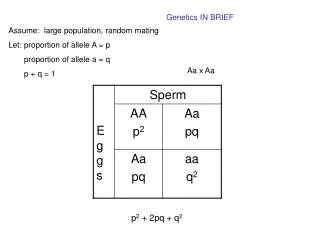
Genetics IN BRIEF Assume: large population, random mating Let: proportion of allele A = p proportion of allele a = q p + q = 1 Aa x Aa p2 + 2pq + q2
Hardy-Weinberg equilibrium p2 + 2pq + q2 Χ2 = (1787-1782.7)2/1782.7 + (3037-3045.6)2/3045.6 + (1305-1300.7)2/1300.7 = 0.04887 Probability associated with this value and 1 d.f. = 0.90
Factors that cause populations to go out of HWE Drift Mutation Immigration Selection Inbreeding/asexual reproduction Founder effects Bottlenecks
Inbreeding Inbreeding coefficient (I)
Fst = fixation index or amount of genetic differentiation among subpopulations Hs = 2pi(1-pi) Ht=2pi(1-pi) Fst=(Ht-Hs)/Ht Fst=∑pi(1-pi)Fst/ ∑pi(1-pi) .05-.15 = moderate differentiation .15-.25 = great differentiation
Other genetic terms and calculations: Average Heterozygosity Genetic Diversity Genetic Distance Relatedness