
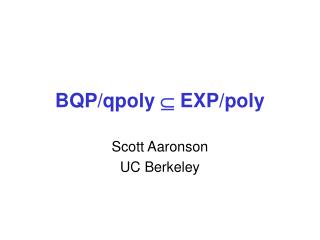
Exploring the Relationship Between BQP/qpoly and Classical Complexity Classes
This paper investigates the quantum complexity class BQP/qpoly, recognized by bounded-error polynomial-time quantum algorithms with polynomial-size quantum advice. We establish that BQP/qpoly is contained within EXP/poly, suggesting that an unrelativized separation between BQP/poly and BQP/qpoly is implausible, as it would imply contradictions in classical complexity classes. Our proof uses exponentially small error probabilities and an intricate analysis of subspaces related to quantum states. We also outline open questions regarding oracle separations and natural problems within BQP/qpoly.

Exploring the Relationship Between BQP/qpoly and Classical Complexity Classes
E N D
Presentation Transcript
BQP/qpoly EXP/poly Scott Aaronson UC Berkeley
BQP/qpoly • Class of languages recognized by a bounded-error polytime quantum algorithm, with a polysize quantum advice state |n that depends only on the input size • Buhrman: Is BQP/qpoly anything/poly?
Our Result • BQP/qpoly EXP/poly • Means we shouldn’t hope for an unrelativized separation between BQP/poly and BQP/qpoly—since it would imply P/poly EXP/poly, which is equivalent to EXP P/poly
Proof Sketch • Given a BQP/qpoly algorithm, make error prob. exponentially small by taking |np(n) as advice • On input x{0,1}n, loop through all yx in lexicographic order • For i{0,1}, let Si be set of advice states that cause algorithm to output i with prob. 1-c-n. Then there exist orthogonal subspaces H0,H1 s.t. all states in Si are exponentially close to Hi • To see this: acceptance probability on advice | can be written |x|, for some Hermitian p.s.d. x with eigenvalues in [0,1]. Let H0,H1 be subspaces spanned by eigenvectors of x corresponding to eigenvalues in [0,1/3], [2/3,1] respectively
H1 The Subspaces H0 • Let Ty be subspace of |’s compatible with inputs 1,…,y (initially T0 = whole Hilbert space) • Let Ty = whichever has larger dimension: projection of Ty-1 onto H0, or projection of Ty-1 onto H1 • Unless classical advice says to pick the subspace of smaller dimension! • Each time we pick smaller subspace, dim(Ty) is at least halved. So advice needs to intervene only polynomially many times
The Subspaces • Can do everything in EXP (diagonalize exponentially large matrix y, loop over all inputs, etc.) • Main technical fact: Error (distance from Ty to |np(n)) stays bounded over all iterations
Open Problems • Oracle separation between BQP/poly and BQP/qpoly • Is BQP/qpoly PSPACE/poly? • Is BQP/qpoly PP/poly relative to an oracle? • Any natural problems in BQP/qpoly (besides cousins of QMA problems)?