Download
1 / 3
30 likes | 147 Vues
Explore the latest research and applications in sketch understanding and recognition presented at the AAAI Spring Symposium. This workshop addresses key topics such as cognitive science related to how individuals use and extract information from sketches, the role of computer vision in sketch capture and recognition, and the integration of multi-modal inputs in Human-Computer Interaction (HCI). With contributions from experts across architecture, mechanical design, and GUI design, gain insight into innovative tools and techniques that enhance sketch-based communication and visualization.

E N D
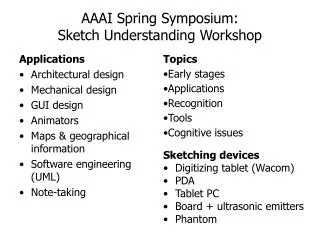
Applications Architectural design Mechanical design GUI design Animators Maps & geographical information Software engineering (UML) Note-taking Sketching devices Digitizing tablet (Wacom) PDA Tablet PC Board + ultrasonic emitters Phantom AAAI Spring Symposium: Sketch Understanding Workshop • Topics • Early stages • Applications • Recognition • Tools • Cognitive issues
Current Research Issues • Cognitive Science – How do people use sketches • What do people extract from sketches • When to recognize precisely; when to be approximate • Computer Vision – Sketch capture • Better recognition, segmentation, focus of attention • Recognizing crisp sketches vs. messy sketches • AI – How to infer & represent the user’s intent • Representation, semantics, reasoning • HCI • Building a seamless interface, Combining multi-modal inputs • Creating, editing & communicating sketches • Software Architecture • Low level processing vs. domain-specific plug-ins • Common toolkits, Building an infrastructure
Best Work • Ellen Do – Architecture; Univ. of Washington http://dmg.caup.washington.edu • Fonseca et al. – Trainable recognizer; Tech. U. of Lisbon http://immi.inesc-id.pt/cali/ • Randy Davis – Simulate a mechanical sketch; MIT • James Landay – GUI Design; UC Berkeley • Mahoney & Saund – Graph representation; PARC • Ken Forbus & Ron Ferguson – Maps; Northwestern • Barbara Tversky – Cognitive issues (maps); Stanford • Phil Cohen & Sharon Oviatt – QuickSet (maps); OGI http://www.cse.ogi.edu/CHCC/Personnel/pcohen.html