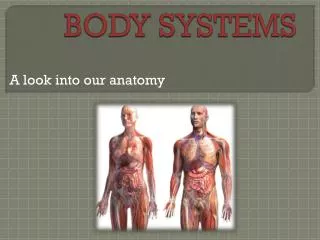
Overview of Human Body Systems: Digestive, Nervous, Endocrine, Respiratory, Circulatory, Lymphatic
This article provides a comprehensive overview of key human body systems including the Digestive, Nervous, Endocrine, Respiratory, Circulatory, and Lymphatic Systems. Each system's primary components and functions are detailed, highlighting how they work together to maintain homeostasis and support bodily functions. Explore the roles of various organs, glands, and the complex interactions between these systems that are essential for health and well-being.

Overview of Human Body Systems: Digestive, Nervous, Endocrine, Respiratory, Circulatory, Lymphatic
E N D
Presentation Transcript
Body Systems
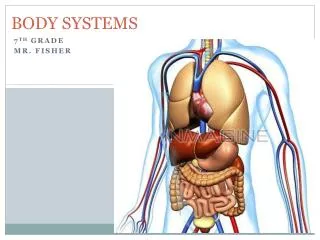
Digestive System Mouth Pharynx Esophagus Stomach Small Intestine Large Intestine Rectum
Nervous System 1. The Nervous System is divided into 2 parts: Central Nervous System Peripheral Nervous System
Central Nervous System Cerebrum – 85% of the brain, controls thinking, long and short term memory. Cerebellum – located at the back of the brain, controls balance. Spinal Cord – connects neurons to the brain
Peripheral Nervous System Made up of hugh network of interconnecting neurons across the body. Cranial Nerve – effects motion and feeling in the face. It does not pass through the spinal cord.
Endocrine System Define Endocrine System: Hypothalamus – Located in the ____________________ part of the brain, regulates _____________________ and ____________________________. System of glands that produce endocrine that help control the body's metabolic activity. lower central satiety metabolism
Pituitary Gland- Located in the _____________ of the brain, no larger than a ______________. Most important gland because it produces hormones that control many functions of other ___________________________. Thyroid Gland– Located in the ________________ of the neck. Produces hormones that regulate the body’s _________________________. Parathyroid Gland– Located on either side of the __________________, it releases hormones that regulate _______________ in the blood and __________________ metabolism. base pea Endocrine glands front metabolism Thyroid gland calcium bone
Adrenal Gland– Located on the ________________, there are 2 parts. The __________________ produces hormones that regulate the body’s _____________________, balance of __________ and ____________, the _____________________ system and ______________ function. The ________________________ produces hormones like __________________. They help the body cope with physical and emotional ________________ by _______________________ heart rate and blood pressure. Kidneys Adrenal Cortex metabolism salt water Immune sexual Adrenal Medulla adrenaline stress increasing
Pinal Gland– Located in the ________________ of the brain, it secretes the hormone ______________________ which helps regulate the _____________________ cycle. Reproductive Glands– The main source of sex ___________________. In males it is the _____________ which produce the hormone ____________________. In females, it is in the _______________________ which produce 2 hormones, _________________ and ___________________. Pancreas–Located behind the __________________, it has _____________________ and ________________ functions. It secretes digestive ___________________ and also secretes hormones called __________________ and ______________________. These regulate the level of ______________________ (sugar) in the blood. middle melatonin Wake sleep hormones testes testosterone ovaries estrogen progesterone stomach digestive hormonal enzymes insulin glucagon glucose
Respiratory System • Nasal Cavity is lined with… • Cilia • Mucous Membranes • Blood Capillaries • Air is … • Filtered by cilia • Moistened by the mucous membranes • Warmed by the blood
Respiratory System A – Lungs B – Alveoli C – Nasal Cavity D – Mouth E – Trachea F – Diaphragm G – Epiglottis H – Bronchia I – Pharynx I G H
Circulatory System heart blood vessels The ________________and _________________ make up the Cardiorespiratory System which CIRCULATES blood throughout your body. The heart is divided into 4 chambers, right ________________ and ____________________ and the left ______________________ and _________________________. Oxygen poor blood, ____________ blood, circulates to the right side of the heart, it is sent to the _______________ to get __________________. The _______ blood is then sent back to the left side of the heart to be circulated back through the _______________. Systole = ______________ Diastole = _____________ atrium ventricle atrium ventricle blue lungs oxygen red body contracts relax
We have lymph nodes all throughout our body.
Lymphatic System The Lymphatic System aids the _______________________ System in transporting ______________ throughout the body and is a vital part of the _______________ System. The ________________________ vessels carry proteins to the _________________ which are filled with ________________ blood cells that kill _______________________ and other pathogens before sending the protein back into the body. Circulatory fluids Immune Lymphatic Lymph nodes white bacteria