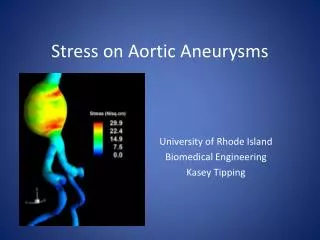
Stress on Aortic Aneurysms
110 likes | 252 Vues
Aortic aneurysms are serious vascular conditions characterized by abnormal blood-filled dilations in the aorta, often leading to severe complications like rupture. This overview covers the location, causes, and risk factors associated with aneurysms, as well as diagnostic methods such as MRI and CT scans. Treatment options, including surgical procedures and medication for smaller aneurysms, are discussed. The benefits of using 3D models to assess aneurysmal wall stress are emphasized, providing insights into improving patient outcomes through tailored approaches.


Stress on Aortic Aneurysms
E N D
Presentation Transcript
Stress on Aortic Aneurysms University of Rhode Island Biomedical Engineering Kasey Tipping
Overview • What/Where/ Why/ Who • How is it diagnosed? • Treatment • Surgery • Benefits of a 3-Dimensional Model • Effects of the Study • Sources
What? • Aorta : The largest artery in the body, extends from the heart to the lower abdomen • Aneurysm: localized blood filled dilation, causes weakening of the artery wall If this occurs : it causes discomfort, could rupture (severe pain) in which case death could result
Where? • The aneurysms occur in the thoracic and abdominal regions (90%) of the aorta • Abdominal: Start off as asymptomatic, leads to pain in the abdomen and back (AAA) • Thoracic: more evident, chest pain, cough, shortness of breath • Tend to be spindle shaped
Why? • Arterioclerosis: hardening of the arteries (80%); • Post-trauma: physical trauma to aorta • Genetic disease/ hereditary: rare inheritable disease of connective tissue (Ehlers-Danlos or Marfan’s) • Infection: syphilis or endocarditis Risk factors • Smoking, high blood pressure, high cholesterol, age
How is it Diagnosed? • MRI, Ultrasound, CT scan Treatment Larger Aneurysms (>5.5cm) • Surgery: physically capable or whether it can be postponed Smaller Aneurysms (<5.5cm) • Beta blockers (high blood pressure and cholesterol meds) Both: No smoking, exercise, heart-healthy diet
Surgery • Open heart surgery • Major surgery • Low to average risk patients • Sewing in a synthetic tube • Endovascular Stent Graft • Minimally invasive • Guiding a wire carrying a catheter from the femoral artery to the aneurysm, and a fabric tube is fitted in place to reinforce the walls
Benefits of a 3-Dimensional ModelPeak wall stress = Rupture point 2-D 3-D
The Study • 5 patients with AAA • Three constitutive models: two anisotropic ( 1&2) and one isotropic • Used to model the mechanical behavior of the aneurysmal wall • CT scan, calculations, MATLAB, outcome
Results Isotropic Anisotropic (1) Anisotropic (2) Isotropic Anisotropic (1) Anisotropic (2)
Work Cited • Works Cited: • -The Effect of Material Model Formulation in the Stress Analysis of Abdominal • Aortic Aneurysms 37.11 (09): 2218-221. Print. • -Aortic Aneurysm. Yahoo Heart & Vascular Health, 2010. Web. 17 Feb. 2010. • -Aortic Aneurysm. WebMd, 2010. Web. 18 Feb. 2010. • -Aortic Aneurysms. The Society of Thoracic Surgeons, 2010. Web. 16 Feb. 2010.