The Formation and Stability of Silica Polymorphs: Quartz, Tridymite, and Chalcedony
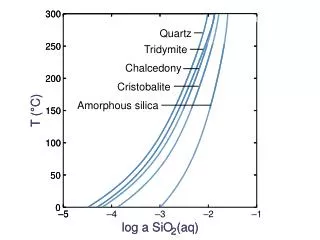
This study investigates the solubility and formation conditions of various silica polymorphs, including quartz, tridymite, chalcedony, cristobalite, and amorphous silica. By sequentially suppressing the most stable phase, quartz, we can better understand the formation of less stable polymorphs like tridymite and chalcedony. The presented figures illustrate the temperature-dependent solubility of these phases, providing valuable insights into silica behavior under different conditions.

The Formation and Stability of Silica Polymorphs: Quartz, Tridymite, and Chalcedony
E N D
Presentation Transcript
300 300 Quartz 250 250 Tridymite Chalcedony 200 200 Cristobalite Amorphous silica T (°C) T (°C) 150 150 100 100 50 50 0 0 –5 –4 –3 –2 –1 –5 log a SiO log a SiO (aq) (aq) 2 2
Config → Suppress… Solubility of Quartz
Suppress Quartz to allow less stable silica polymorphs to form.
Suppressing Quartz allows Tridymite and Chalcedony to form.
300 300 Quartz 250 250 Tridymite Chalcedony 200 200 Cristobalite Amorphous silica T (°C) T (°C) 150 150 100 100 Figure created by sequentially suppressing the most stable phase, then copying into PowerPoint. 50 50 0 0 –5 –4 –3 –2 –1 –5 log a SiO log a SiO (aq) (aq) 2 2