Download
1 / 4
40 likes | 170 Vues
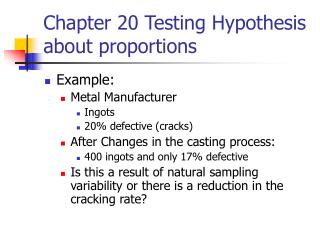
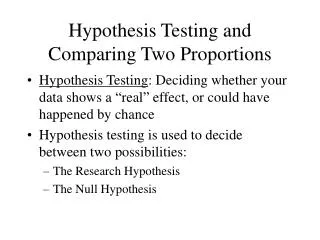
This guide outlines the process for conducting a hypothesis test involving population proportions. A proportion, synonymous with population percentage, can be tested using the specific formula for test value: ( z = frac{(X - mu)}{sigma} = frac{(X - np)}{sqrt{npq}} ), where ( mu = np ), ( sigma = sqrt{npq} ), and ( q = 1 - p ). The steps include stating the null and alternative hypotheses, determining critical values, calculating mean and standard deviation, computing the test value, and making a decision on the null hypothesis.

E N D
Conducting a Hypothesis Test Using Proportions
Note: a proportion is the same as the percentage of the population
Formula for the test value for proportions: ( X – µ ) ( X – np ) z = or σ √npq Where: µ = np σ = √(npq) q = 1 – p
Steps for Hypothesis Test For proportions State the null and alternative hypotheses (using p) 1) 2) Find the critical value(s) using z-table 3) Find the mean and standard deviation (Round to 2 decimals) 4) Compute the test value 5) Make the decision to either “reject the null” or “fail to reject the null”