Download
1 / 6
60 likes | 200 Vues
In this presentation, Michelle Williams-Ward shares her transformative journey in the field of forensic anthropology, showcasing her evolution from a mature undergraduate to a PhD candidate. She reflects on her initial intrigue with human remains, highlights the importance of ethical considerations, and discusses the diverse learning experiences at Bradford University. Through engaging with over 4,000 skeletons, she emphasizes the value of teaching with human remains while respecting individual beliefs. Join her as she explores the challenges and profound insights gained from this unique educational path.

E N D
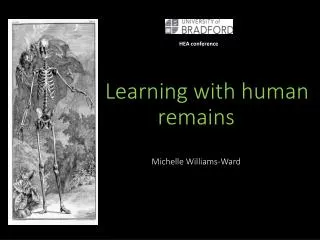
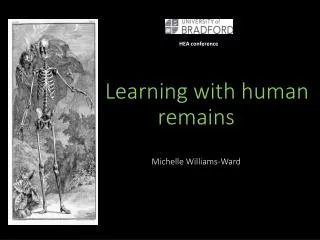
HEA conference Learning with human remainsMichelle Williams-Ward
My Background • Undergraduate degrees • Masters degree • Job • Currently PhD • My development • Initial plan on attending Bradford: to work in forensic context • Worked with mentally disordered offenders: very little shocks me • Most taught aspects as an undergraduate were associated with the living • Archaeology was relatively new to me / Scientific v theoretical (struggle at times) • Mature student – change to plans and interests
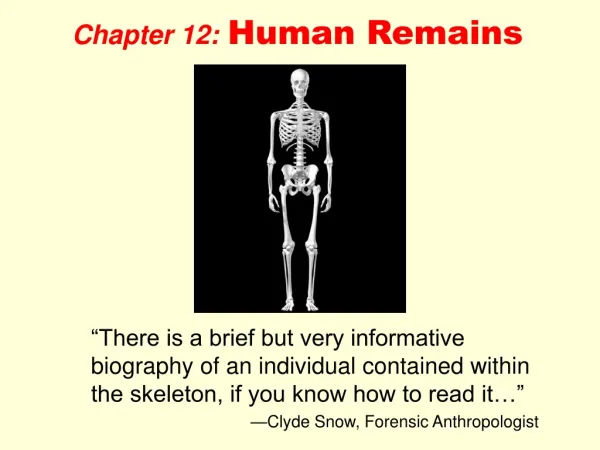
Human remains and me! • Although I planned to work with forensic human remains • looked at pictures / books • NEVER TOUCHED ANY!! • 3rd year module : Forensic anthropology • ‘THE MODULE THAT CHANGED MY LIFE’ • Introduced to the human skeleton • The enthusiasm for the material and discipline was infectious • The respect for skeletons started here • WHO KNEW SKELETONS WERE SO INTERESTING • Started my Masters degree – skeletons became part of my life
Learning with human remains • ITS HARD!!! • Awareness of ethical and legal considerations AND diversity in beliefs • Taught from day one: Valuable resource, treat with respect and care • Bradford over 4000 skeletons, differing time periods (Diversity of human remains useful) • How I learned wasn’t necessarily how others learned • Better than plastic – detail: pathologies /features / muscle attachments • Desensitised: but always aware that these were people • Fascinated and still learning • More I learn from these individuals - more valuable the resource
Teaching with human remains • New to teaching anything • Demonstrating in human remains labs / Workshops / Lecture / seminar • Mixed responses • Some loved the plastic skeletons (no frame of reference) • Some felt uncomfortable • Once most got past initial discomfort and began to acquire info – loved it • Most Surprised : amount of info that can be obtained from the skeleton
How I am beginning to approach teaching / informing others • Much more comfortable explaining with bones, real or plastic than in a classroom setting • I often get a real bone out to highlight a point in the lab • My learning experiences directly influence everything I do • Differing individuals – fit the audience (WEA / A-LEVEL / MSc) • Most importantly • A sense of responsibility and privilege • Feel protective!! Stress upfront that care and respect of this valuable resource is paramount • Remember that others don’t necessarily feel as comfortable as I do