Exploring the World of Bacteria: Prokaryotic Wonders and Significance in Life
Delve into the realm of bacteria, the fascinating prokaryotic microorganisms ubiquitous in nature. Learn about Eubacteria and Archaebacteria, their identification, movement, energy acquisition, respiration, reproduction, growth, and importance in various fields from food production to environmental reclamation. Discover the symbiotic relationship between bacteria and humans, sewage decomposition, nitrogen fixation, diseases caused by viruses and bacteria, and preventive measures like antibiotics and sterilization techniques.

Exploring the World of Bacteria: Prokaryotic Wonders and Significance in Life
E N D
Presentation Transcript
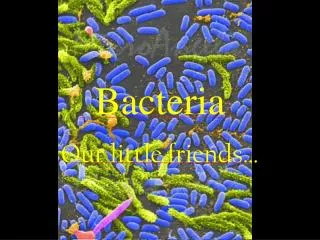
Bacteria Our little friends…
Prokaryotes • Cells without a nucleus • Bacteria • Ubiquitous
Prokaryotes • 2 kingdoms- • Eubacteria • Archaebacteria
Eubacteria • Protective cell wall • Can have 1-2 layer membrane in cell Wall. • Found everywhere • Cyanobacteria
Cyanobacteria • Most important Eubacteria • Blue-green pigment, no chloroplasts • Found in extreme conditions
Archaebacteria • Lack Eubacteria carbohydrate in cell wall (peptidoglycan) • Oxygen free living aka.. methanogens • Live in extremes salt, acid & temp.
Identification • Shape • Cell wall • Movement
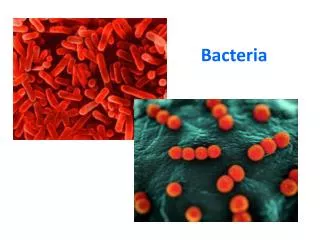
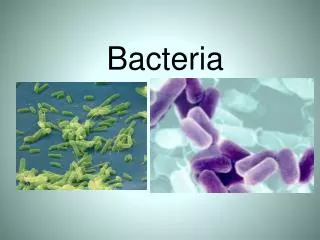
Shape • Rod- bacilli (plural) -bacillus (singular)
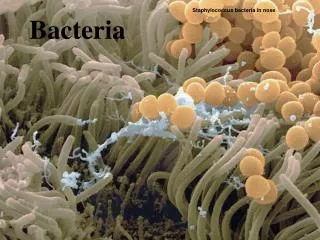
Shape • Round- Cocci • Staphylococcus epidermidis • Chains/clumps/pairs
Shape • Spiral- spirilla • Leptospira • syphilis
Cell Wall • Gram stain- Hans Gramm • Blue- gram (+) 1layer • Red- gram (-) 2 layers 1layer- Carbohydrates 2 layer- lipid Membrane
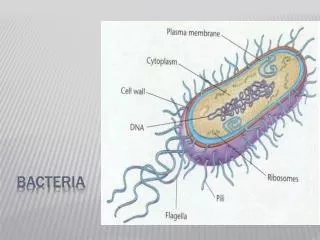
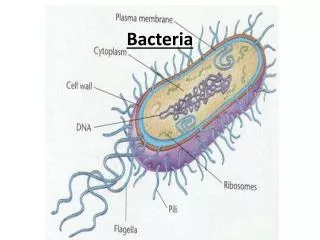
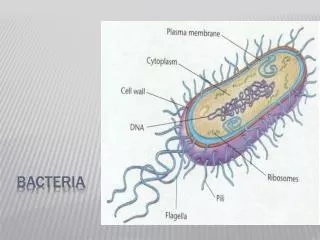
Movement • Flagella- 1 or more • Pili-hairs and attachment • Gliding- slimelayer • Capsule-glycocalyx(stick sugar) • Some don’t move
Getting Energy • Autotrophs • Phototroph • Chemotroph
Getting Energy • Heterotrophs • Chemotrophic… • Phototrophic… -use both light and organics
Respiration • Obligate aerobes • Must have O2 • Obligate anaerobes • Poisoned by O2
Clostridium botulinum • Ex. Of Anaerobe • Grows and produce toxins • Botulism causes paralysis
Facultative Anaerobes • Don’t need O2 • Aren’t poisoned by O2
Reproduction • Binary Fission Genetic Recombination • Trasformation, Transduction • Conjugation- Pili • Spore formation endospore
Growth • Some can reproduce in 20 minutes • How many in 24 hours?
Importance of Bacteria • Used to make foods • Cheese • Yogurt • Pickles
Other uses of bacteria • Oil spill cleanup • Water reclaimation • Making drugs ex. • E.Coli & insulin
Bacteria and YOU! • Symbiosis • Intestines E. Coli • Skin • Mouth
Bacteria All Around • Nutrient flow • Bacteria recycle and decompose dead material!!! What would happen if no bacteria
Saprophytes • Name for bacteria which decompose complex organic molecules into soil and nutrients
Sewage Decomposition • Ex. Fish Tanks • Ammonia-> Nitrites • Nitrites-> Nitrates • Clean fish water
Nitrogen Fixation • All Living things need Nitrogen • N2 in the atmosphere is not usable
Cyanobacteria can make nitrogen usable • “Nitrogen Fixation” • Rhizobium in beans nodulescrop rotation
Pathogens • Disease producing agents.. • Can include more than just viruses and bacteria
HIV Mumps Yellow fever Common cold Virus caused disease
Cancer • Oncogenic viruses • Rous sarcoma virus in chickens
Antibiotics • Can attack bacterial cells
Sterilization • Fire • Disinfectant- lysol • Radiation
Food Processing • Refrigeration • Cooking • Preservatives- salt vinegar…