The Cold War
This overview of the Cold War delves into the ideological confrontation between the capitalist United States and the communist Soviet Union from 1946 to 1956. It covers key concepts such as free market and planned economies, individual versus group achievements, and the role of government control. The emergence of fear, suspicion, and competitive ideologies is highlighted, including the influence of McCarthyism and the House Un-American Activities Committee. Understanding the dynamics of this era is crucial to grasping the political tensions that shaped modern history.

The Cold War
E N D
Presentation Transcript
The Cold War The creation of a War of ideas. 1946-1956
Definitions • Economy • Goods and Services • Free Market Economy • People decide what to make and sell • Planned economy • Government directs the economy
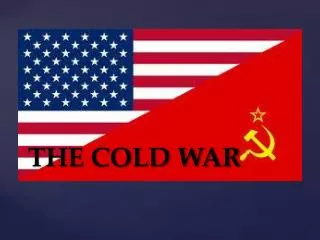
Capitalism (U.S.A.) Free Market Individual achievement Competition Free Religion Reduced State Control Communism (U.S.S.R.) Planned economy Group achievement Cooperation Atheism Strong State Control Lesson One: Ideologies Both • Greed • Power • Inequality
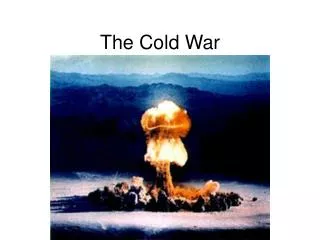
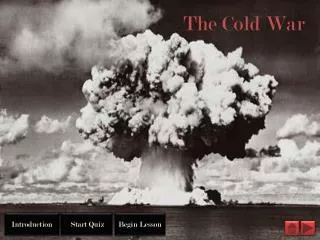
Lesson Two: Perception • WWII ended with Hiroshima and Nagasaki A-bombs • U.S. and Soviet Union became enemies • Soviets had Spies and stole plans for A-bomb • Began competition of ideologies and weapons • Suspicion and Fear
Lesson Three: Suspicion • HUAC • House Un-American Activities Committee • Blacklists • McCarthyism • Hunt for Communists
Lesson Four: Fear • Two types of fear: Internal and External • Internal Fear: Espionage • External Fear: Sneak Attack • Student Education
Lesson Five: Confrontation Policy • Domino theory • Countries will fall to communism like dominos • Containment • Keep Communism where it is