Download
1 / 4
40 likes | 163 Vues
Explore the fascinating world of salts, essential ionic compounds formed through neutralization reactions between acids and bases. Salts, like sodium chloride (NaCl), are crucial dietary nutrients and hold 14,000 known uses across industries such as pharmaceuticals, textiles, and cosmetics. Learn about various methods of salt formation, including reactions between metals and acids, and carbonate reactions with acids. Discover how both metals and non-metals form oxides, contributing to the vast diversity of salt types and their roles in everyday life.

E N D
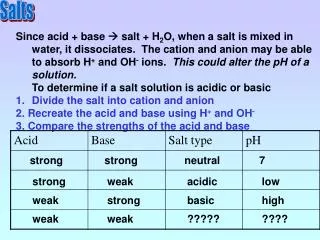
Salts • A salt is made up of positive ions (base) and negative ions (acid). • Salts are ionic compounds formed during the neutralization reaction of an acid and base. Some Interesting Facts about Salt • An essential dietary nutrient (NaCl) • The world’s oldest food additive • Has 14,000 known uses: Chlorine Industry involved in production of pharmaceuticals, textiles, cosmetics, water filtration and much much more!
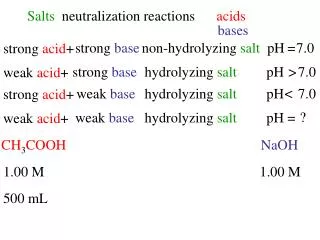
How Salts are Made • 1. Neutralization Reaction: HCl + NaOHNaCl = H2O acid + base salt + water • 2. Metals: react with acids they produce a salt and H2 gas: HCl(aq) + Mg(s) MgCl2(aq) + H2(g) • Most reactive metals are the alkali metals and alkaline earth metals. Reactivity increases towards the bottom of these groups. • 3.Carbonates (CO3): react with acids to produce salts and CO2 gas: H2SO4 + CaCO3 CaSO4 + H2O + CO2
Oxides • A chemical compound that includes at least one O2atom or ion along with one or more other elements. • Both metals and non-metals can form oxides. 1. Metal Oxides: chemical compounds that contains a metal chemically combined with O2 forming a base. Na2O(s) + H2O(l) 2NaOH(aq) 2. Non-Metal Oxides: chemical compounds containing a non-metal combined with O2 forming an acid: CO2(g) + H2O(l) H2CO3(aq) These acids and bases can go on to react with each other to produce a salts!!