

SlideServe
Menu
Préférences
© SlideServe · v2026

Armada

chas avatar
1 diapositives · 227 Views · Oct 11, 2014

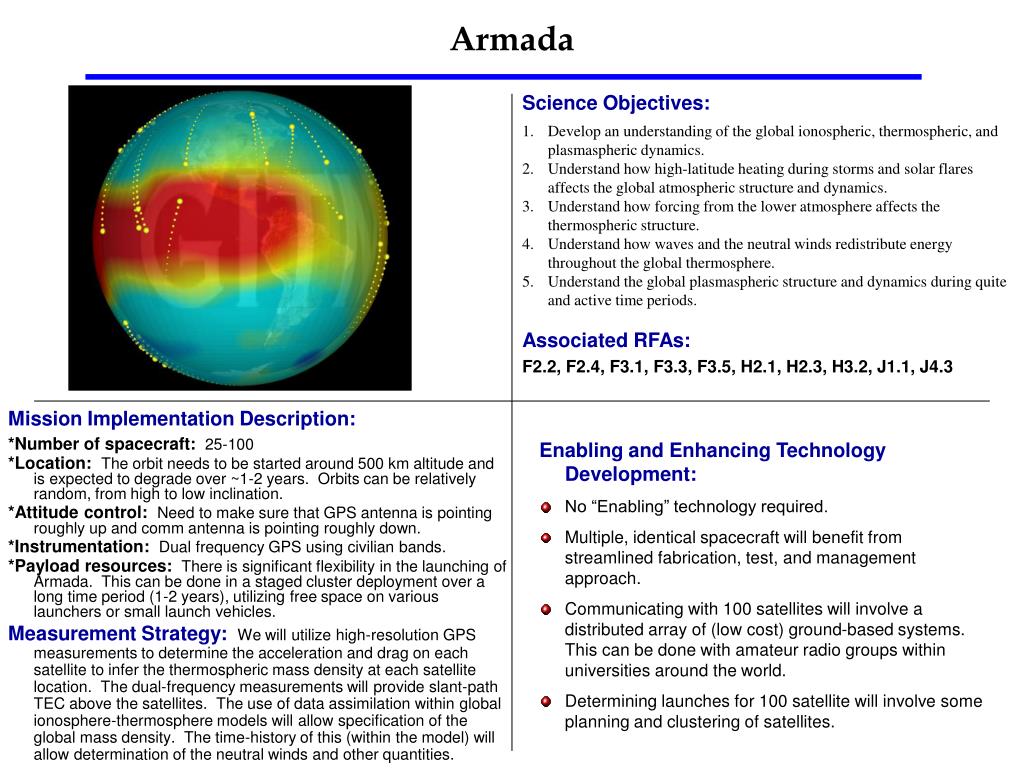
Armada. Science Objectives: Develop an understanding of the global ionospheric, thermospheric, and plasmaspheric dynamics. Understand how high-latitude heating during storms and solar flares affects the global atmospheric structure and dynamics.
Armada - slide 1
01 / 1Armada
1 / 17

Télécharger la présentation

Armada
Une image / un lien ci-dessous est fourni (tel quel) pour télécharger la présentation

Politique de téléchargement : le contenu du site vous est fourni TEL QUEL pour votre information et votre usage personnel ; il ne peut être vendu, concédé sous licence ni partagé sur d’autres sites sans l’accord de son auteur.Le contenu vous est fourni TEL QUEL, pour votre information et votre usage personnel uniquement. Téléchargez la présentation en cliquant sur ce lien. Lors du téléchargement, si vous ne parvenez pas à télécharger une présentation, l’éditeur a peut-être supprimé le fichier de son serveur.Pendant le téléchargement, si vous ne parvenez pas à obtenir une présentation, le fichier a peut-être été supprimé par l’éditeur.

F I N

Plus de contenu associé

Transcription de la présentation
  1. Armada • Science Objectives: • Develop an understanding of the global ionospheric, thermospheric, and plasmaspheric dynamics. • Understand how high-latitude heating during storms and solar flares affects the global atmospheric structure and dynamics. • Understand how forcing from the lower atmosphere affects the thermospheric structure. • Understand how waves and the neutral winds redistribute energy throughout the global thermosphere. • Understand the global plasmaspheric structure and dynamics during quite and active time periods. • Associated RFAs: • F2.2, F2.4, F3.1, F3.3, F3.5, H2.1, H2.3, H3.2, J1.1, J4.3 Mission Implementation Description: *Number of spacecraft: 25-100 *Location: The orbit needs to be started around 500 km altitude and is expected to degrade over ~1-2 years. Orbits can be relatively random, from high to low inclination. *Attitude control: Need to make sure that GPS antenna is pointing roughly up and comm antenna is pointing roughly down. *Instrumentation: Dual frequency GPS using civilian bands. *Payload resources: There is significant flexibility in the launching of Armada. This can be done in a staged cluster deployment over a long time period (1-2 years), utilizing free space on various launchers or small launch vehicles. Measurement Strategy: We will utilize high-resolution GPS measurements to determine the acceleration and drag on each satellite to infer the thermospheric mass density at each satellite location. The dual-frequency measurements will provide slant-path TEC above the satellites. The use of data assimilation within global ionosphere-thermosphere models will allow specification of the global mass density. The time-history of this (within the model) will allow determination of the neutral winds and other quantities. • Enabling and Enhancing Technology Development: • No “Enabling” technology required. • Multiple, identical spacecraft will benefit from streamlined fabrication, test, and management approach. • Communicating with 100 satellites will involve a distributed array of (low cost) ground-based systems. This can be done with amateur radio groups within universities around the world. • Determining launches for 100 satellite will involve some planning and clustering of satellites.