Understanding Earth's Layers: Composition, Structure, and Temperature
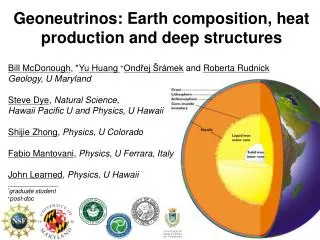
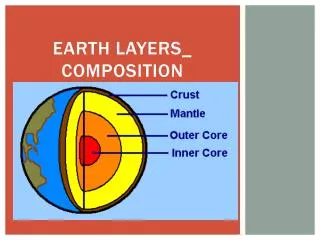
Explore the intricate structure of Earth's layers, including the thin crust, expansive mantle, and dense core. The crust, ranging from 5 to 100 km and comprising less than 1% of Earth's mass, is divided into continental and oceanic types. The mantle, 2,900 km thick, holds 67% of Earth's mass and contains heat from 1,000 to 3,700°C, driving mantle rock to the surface. The outer core is a liquid iron layer, while the inner core is solid and also made of iron, with minimal quantities of other elements. Discover how each layer contributes to Earth's geology.

Understanding Earth's Layers: Composition, Structure, and Temperature
E N D
Presentation Transcript
Crust • 5 – 100 km thick • Less than 1% of Earth’s mass • Temperature_ 0 C⁰ – 1,000 C⁰ • It’s the thinnest layer of the Earth • Continental Crust_ made of oxygen, silicon, & aluminum • Oceanic Crust_ is denser • Oceanic Crust_ has twice as much iron, calcium and magnesium
Mantle • It is 2,900 km thick • Contains 67% Earth’s mass • Temperature_ 1,000⁰ C- 3,700⁰ C • Mantle rock pushes to surface • Ocean floor contains magma from underwater volcanoes • Contains more magnesium and less aluminum and silicon • Mantle is denser than crust
Outer Core • 1/3 of Earth’s mass_ • Temperature 3,700⁰ C – 7,000⁰ C • Radius is 3.430 km • Made of iron • Has smaller amounts of nickel; • Almost no oxygen, silicon, aluminum or magnesium
Inner Core • Solid layer of core • Made of iron • Has smaller amounts of nickel; • Almost no oxygen, silicon, aluminum or magnesium