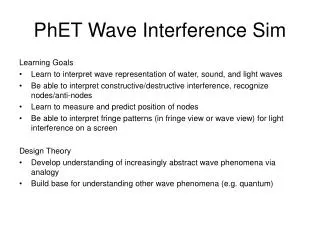
PhET sim conclusions
This exploration focuses on how metal-containing molecules, specifically nickel complexes, demonstrate color due to electronic transitions influenced by ligand field theory. We analyze various ligands, such as NH3, en (ethylenediamine), Cl-, and H2O, to understand their impact on the vibrational energy of complexes like [Ni(NH3)6]2+, [Ni(en)3]2+, [NiCl4]2-, and [Ni(H2O)6]2+. We also discuss general trends in vibrational modes and the relationship between the electromagnetic spectrum and the color these complexes exhibit.

PhET sim conclusions
E N D
Presentation Transcript
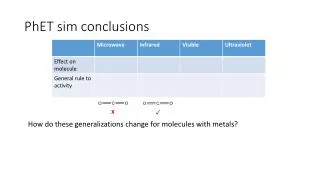
PhETsim conclusions X ✓ How do these generalizations change for molecules with metals?
Electromagnetic Spectrum Low energy High energy Long wavelength Short wavelength
Lab 6 # vibrational modes _____ nitrite ion nitrito nitro In general, the vibrational energy is _________ for the ligand compared to the free ion
Ligand Field Theory [Ni(NH3)6]2+ [Ni(en)3]2+ [NiCl4]2- [Ni(H2O)6]2+ These ligands are colorless on their own, but each Ni2+ (d8) complex is colored. Why?????