Innovative Conformal Computing Displays for Flexible Computing Applications
This research explores conformal computing displays developed by NDSU's Center for Nanoscale Science and Engineering and MIT's Center for Bits and Atoms. The project focuses on extensible, flexible substrates that integrate computation and display functionalities. Prototypes include various strip configurations and tactile arrays designed for sensory substitution. With applications in distributed graphics and interactive I/O, the study aims to advance operational efficiency in computing displays while minimizing costs. It utilizes state-of-the-art microcontrollers and assembly methods for scalable production.

Innovative Conformal Computing Displays for Flexible Computing Applications
E N D
Presentation Transcript
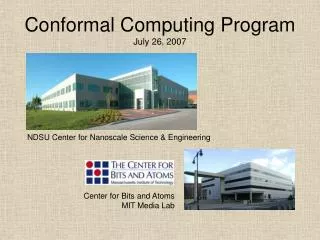
Conformal Computing ProgramJuly 26, 2007 NDSU Center for Nanoscale Science & Engineering Center for Bits and Atoms MIT Media Lab
CNSE CC Team (not pictured: Ahana Gosh and Jordan Dahl)
Wallpaper Computing Display • Extensible Medium • Integrated Computation and Display • Flexible Substrate • Similarities to Wallpaper
WCD Prototypes • Rigid 2x2 and 8x8 Prototypes • Strip Concept • Strip Prototypes
Each processor scans 48 LEDs … Processor + R’s + C 4 x 4 RGB Pixels
8x8 Prototype (1 processor and 16 pixels / cm2) computing side display side
Strip Concept • Uses only two metal layers Lower cost, thinner, more flexible • Strips combine to form sheets Extensible
1x8 Strip Layout Layer 1 (display side) Layer 2 (computing side)
2nd Strip Prototype computing side display side
Flat Strip Display • Top: thin 2-layer boards • Bottom: thick multi-layer boards • Must include processor-to-display cxns • No vias in strip-to-strip power distribution
Applications • Application Services • CA Emulation • Distributed Graphics • Interactive I/O • Tactile Array • LED Camera
Application Services • Provides common application functions • Functions include: • Initial program loading (IPL) • Display setting and refreshing • Inter-processor communication (IPC) • Message passing • Thread management • Subsequent program loading
CA Emulation • Each cell has 8 configuration bits and 1 state bit • A text file format has been defined to specify the configurations and initial states of an array of cells • The text file is used to define the program to be loaded into a wallpaper computing display • A message passing sequence is used to exchange data between the subarrays emulated by individual processors
Distributed Graphics • Purpose • Explore distributed applications capabilities using the 2x2 and 8x8 prototypes • Objective • Render a single graphics primitive (a quadrilateral) in a distributed fashion
Approach • Load all processors with same program • Inject a message into the array via one of the peripheral processors; the message describes the primitive to be rendered • Each processor renders a sub-image and passes a copy of the message to two of its neighbors • Duplicate messages are discarded
Algorithm A (a1, a2) B (b1, b2) border pixel D (d1, d2) outside pixel inside pixel C (c1, c2)
Tactile Array Purpose Produce an example of actuation integrated with a conformal computer Objective Tactile array for sensory substitution
Tactile Display Prototype Testbed for tactile transduction on forehead; uses biofeedback Sensor system Ultrasound range finders in fly’s eye configuration Accurate 3.5 meter range sensing Display system Electromechanical actuators Processing 3 microcontrollers in master-slave configuration
Transduction produced by brush on plastic disk Stepper motor driven by Pulse-width modulation Short envelope duty cycle Performance No audible noise Relatively low power Stepper Motor & Brush
Programmable Cellular Arrays • (Larger Arrays of Microcontrollers) • Programmable Cellular Array ASIC • Assembling Large Arrays of ASICs • (Using the 3rd Dimension)
CA Processors • Purpose • Scale processors down in size (and complexity) and up in number • Objectives • Design CMOS ASICs with arrays of simple computational cells • Consider sync & async approaches
Assembly Methods • Via-to-Pad • Roll-to-place (Part Printer) • FSA • R2R Flip-Chip on Flex • Selective Device Transfer
Roll-to-Place • Parts are “printed” from dispensers • Dispensers are at fixed locations relative to the roll • (See MIT-CBA for dispenser mock-up)
Selective Device TransferFigure from www.zurich.ibm.com/st/server/selectivetrans.html