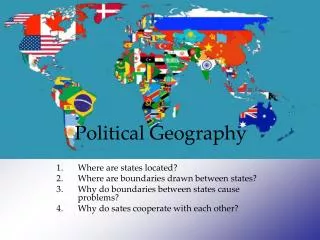
WHAT IS GEOGRAPHY?
Geography encompasses much more than just the locations of places on a map. Geographers aim to understand the "why" behind the "where," exploring the significance of spatial relationships and their impacts. This study delves into map fundamentals, including cartography and various map projections, revealing how each type can distort information about distance, shape, area, and direction. With examples like the Mercator, Peters, Fuller, and Robinson projections, we'll examine how each map serves a unique purpose and the implications of these differences for understanding our world.

WHAT IS GEOGRAPHY?
E N D
Presentation Transcript
Most people think geography is just about simply knowing where things are on a map.
If the answer is “YOU BET IT DOES!” that is when geographers want to investigate! BUT . . . does it make a difference where things are located?
BIG IDEA Geographers study the WHY of the WHERE.
CARTOGRAPHY Map-Making – Geography is more than just maps!
“All maps lie flat, and all flat maps lie.” Information left ___(off) Size Color
Lesson 7 – Unit 2 MAP PROJECTIONS
Map Projection Flat Surface Geoid
Distortion • No three-dimensional shape can be transformed to two-dimensional shape without losing some detail or distorting some features: • DISTANCE • SHAPE • AREA • DIRECTION
Mercator Projection • Accurate compass direction • Distorts the area of landmasses • Works well for ocean navigation – distance is true everywhere on the map
Peter Projection • Accurate sizes of landmasses • Controversial – why?
Fuller Projection • Maintains accurate size and shape of landmasses • Completely rearranges direction – no cardinal directions
Robinson Projection • Does not maintain accurate area, shape, distance, or direction, but minimizes errors – Used in most classrooms