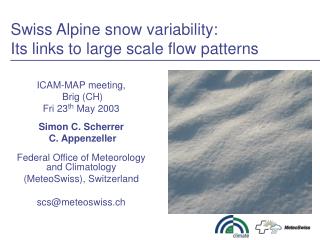
Swiss Alpine snow variability: Its links to large scale flow patterns
170 likes | 288 Vues
This research investigates the variability of new snow in the Swiss Alps and its connection to large-scale atmospheric flow patterns, particularly the North Atlantic Oscillation (NAO). Through a comprehensive analysis of historical snow data from 1931 to 1999, the study identifies three distinct patterns of new snow variability and their relationship with the NAO. Findings reveal a complex interaction where the influence of the NAO on snow totals is not straightforward, highlighting the role of regional atmospheric conditions. The study concludes that while NAO patterns exist, local phenomena significantly drive snow variability.


Swiss Alpine snow variability: Its links to large scale flow patterns
E N D
Presentation Transcript
Swiss Alpine snow variability:Its links to large scale flow patterns ICAM-MAP meeting, Brig (CH) Fri 23th May 2003 Simon C. Scherrer C. Appenzeller Federal Office of Meteorology and Climatology (MeteoSwiss), Switzerland scs@meteoswiss.ch
Swiss snow variability • Klosters 1999 (GR) • Engadin (GR)
Swiss new snow - NAO: direct influence 1931-1999 • Argument: There is a NAO – Alpine snow relation, dependent on height and has an impact on trends • Question: Is there a pronounced NAO influence on Swiss new snow variability and trends?
48°N Germany France Austria S P L A 46°N Italy 6°E 11°E 89 stakes New Swiss new snow data set • A new roughly homogenous snow data set (1931(57)-1999)
EOF analysis of Swiss DJF new snow sums: EOF 1 58% (sign.) r = 1 r = 0.30 No trend
Swiss DJF new snow sums: EOF 2 15% (sign.) r = 1 r = -1 r = 0.30 r = -0.30 No trend
Swiss DJF new snow sums: EOF 3 8% (sign.) r = 1 r = -1 r = 0.30 r = -0.30 small trend
2500 r~-0.6 2000 1500 Altitude [m a.s.l.] 1000 500 0 Correlation coefficient New snow EOF‘s: height dependence • EOF 3 shows a distinct height dependence
DJF EOF– NAOI relation Trend PC 3 not significant (p=0.22) • r (PC1, NAOI) = -0.24 • r (PC2, NAOI) = -0.29 • r (PC3, NAOI) = -0.57**
95% 99% PC 3 Running correlations: New snow sums - NAOI NEW SNOW PC‘s - NAOI
Correlation maps: SLP – (new snow PC3) SLP Pattern 3: „NAO like“ SVD 3: SCF: 5% r = 0.70
„European“ scale: seems to be determined by central European high-pressure regime or low-pressure • Hemispheric scale: SVD 1 resembles NAO/AO like pattern on hemispheric scale NAO/AO – blocking relation? Swiss Alpine region SVD 1: European and Hemispheric view SVD 1HN - SLP 4 1 - 1 - 4 mbar
Influence of “blocking” Atlantic ocean Atlantic ocean 60°N NAO+ 50°N NAO- DJF “blocking” frequency DJF “blocking” frequency NAO- Swiss Alps Swiss Alps NAO+ based on standard TM Blocking Index modified central latitude
Conclusions • Three distinct DJF new snow patterns are identified (expl. var. 81%) • There is no simple 1:1 relation between DJF new snow and the NAOI • The direct influence of the NAO on DJF new snow sums: • is expressed as low-station high-station pattern (expl. variance ~8%) • shows a distinct trend since the 1960‘s • The primary DJF new snow variability: • is locally driven by central European high-low pressure (blocking?) • is NAO/AO like on a hemispheric scale • The “Blocking” – NAO relation is ambiguous: • Atlantic “blocking” is negatively correlated with the NAOI • Middle-European “blocking” is positively correlated with the NAOI
THE END THE END
Intermediate conclusions • Three “significant” DJF new snow patterns are identified, which explain 81% of total variability • There is no simple 1:1 relation between Swiss Alpine new snow sums and the NAOI • The direct influence of the NAO on new snow sums: • is expressed as a low – high station pattern (8% var.) • shows a distinct trend since the 1960‘s