
Using the USART
E N D
Presentation Transcript
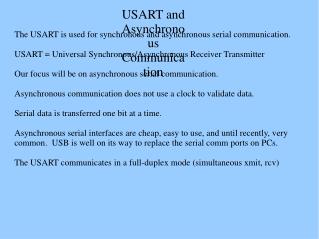
Using the USART Configuration and Programming CE-2810 Dr. Mark L. Hornick
Connection between two communicating serial devices • The Tx (transmit) line of one device is connected to the Rx (receive) line of the second device • Both devices have to be configured identically • Same baud rate, parity, #data bits, #stop bits Tx Tx Rx Rx CS-280 Dr. Mark L. Hornick
Configuration of the USART • Various I/O registers are used to • Control the configuration of the USART • Baud rate (bits/s) • Parity (even/odd/none) • Number of data bits (4-9) • Framing ( 1 or 2 stop bits) • Represent the status of a recent transmission or reception • Frame errors • Data overrun errors • Tx complete • Rx complete CS-280 Dr. Mark L. Hornick
Lots of registers… UCSRA – USART Control/Status Register A Mainly status flags UCSRB – USART Control/Status Register B Flags for enabling transmitting, receiving, interrupts UCSRC – USART Control/Status Register C Mode selection UBRRH, UBRRL– USART Baud Rate Registers Baud rate selection UDR– USART Data Register Does two things at once: • Contains data to be transmitted, or • Data that is received CE-2810 Dr. Mark L. Hornick
Duality of UDR register • UDR– USART Data Register • TXB and RXB I/O addresses overlap • When UDR is read, the contents of the Receive Buffer (RXB) are first shifted into UDR, so that UDR contains the contents of RXB • When UDR is written, the contents are shifted to the Transmit Buffer (TXB) CE-2810 Dr. Mark L. Hornick
USART Baud Rate Registers URSEL – Register select UCSRC I/O address overlaps with address of UBRRH. Set to 0 if writing this Register as UBRRH; otherwise UCSRC UBRR11:0 – Baud Rate select 12-bit register specifying the USART transmit/receive baud rate. Use the following table for calculating the value to place in these bits. BAUD is in bits/sec, fosc is the Atmega32 clock frequency. CE-2810 Dr. Mark L. Hornick
USART Control/Status Register B RXCIE – Receive complete interrupt enable Set to enable Receive Complete Interrupt. Disable to avoid conflicts with Atmon. TXCIE – Transmit complete interrupt enable Set to enable Transmit Complete Interrupt.Disable to avoid conflicts with Atmon. UDRIE – Data Register Empty interrupt enable Set to enable UDRE Interrupt. Disable to avoid conflicts with Atmon. RXEN – Receiver Enable Set to enable the USART Receiver TXEN – Transmitter Enable Set to enable the USART Transmitter CE-2810 Dr. Mark L. Hornick
USART Control/Status Register A contains status bits you read RXC – Receive complete Set when data is received in the Receive Buffer (RXB) TXC – Transmit complete Set when data in the Transmit Buffer has been completely transmitted and no new data in UDR; manually cleared by writing a 1 to this bit UDRE – Data Register Empty Set when Transmit Buffer is ready to accept new data to be transmitted FE – Frame Error Set when Data in Receive Buffer had a frame error detected DOR – Data Overrun Set when Receive Buffer is full (but unread), and new data is coming in PE – Parity Error Set when Data in Receive Buffer had a parity error detected (if parity checking was enabled) CE-2810 Dr. Mark L. Hornick
USART Control/Status Registers B and C UCSZ2, UCSZ1, UCSZ0 – Character size select Together, these set the number of data bits being transmitted or received Set these to (0:1:1) for 8 data bits; see reference manual for other settings URSEL – Register select UCSRC I/O address overlaps with address of UBRRH. Set to 1 when reading this Register as UCSRC; otherwise UBRRH UMSEL – Mode select Set to 0 for Asynchronous mode UPM1, UPM0 – Parity mode select Parity disabled (0:0), Even (1:0), Odd (1:1), Reserved (0:1) USBS– Stop bit select Set to 0 for framing using a single Stop Bit CE-2810 Dr. Mark L. Hornick
How to use the USART • Set baud rate via UBRRH and UBRRL • Enable Transmit and Receive via UCSRB • Disable all USART interrupts via UCSRB (to avoid Atmon conflicts) • Set Parity, #Data bits, #Stop bits, Async via UCSRC • To Receive: • Poll UDRE bit in UCSRA until set • Received char in UDR • Repeat • To Transmit: • Place character to be written in UDR • Poll TXC bit in USCRA until set • Repeat CS-280 Dr. Mark L. Hornick
The USART can receive while it is transmitting But the TXB and RXB buffers can each hold only one character • So you must keep polling RXC to avoid dropping received characters • And you must poll UDRE before sending another character to ensure that TXC has been emptied CS-280 Dr. Mark L. Hornick