SlideServe
Menu
Préférences
© SlideServe · v2026

Internal Gravity Waves

chogan avatar
21 diapositives · 624 Views · Oct 15, 2014

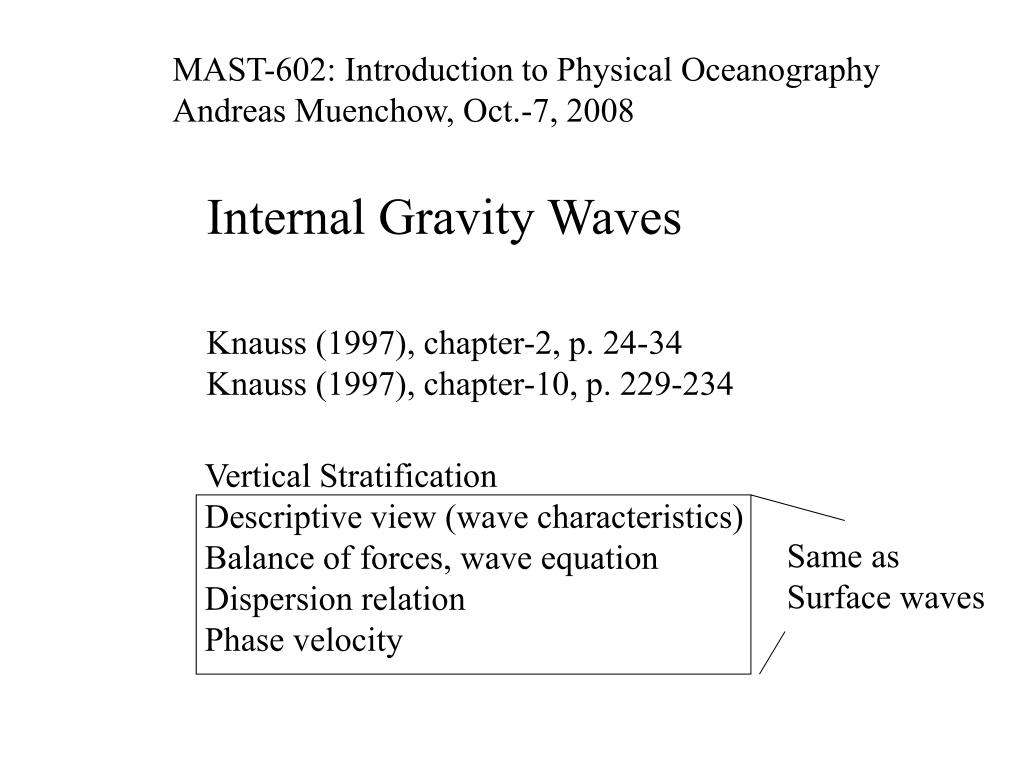
MAST-602: Introduction to Physical Oceanography Andreas Muenchow, Oct.-7, 2008. Internal Gravity Waves. Knauss (1997), chapter-2, p. 24-34 Knauss (1997), chapter-10, p. 229-234. Vertical Stratification Descriptive view (wave characteristics) Balance of forces, wave equation
Internal Gravity Waves - slide 1
01 / 21Internal Gravity Waves
1 / 17

Télécharger la présentation

Internal Gravity Waves
Une image / un lien ci-dessous est fourni (tel quel) pour télécharger la présentation

Politique de téléchargement : le contenu du site vous est fourni TEL QUEL pour votre information et votre usage personnel ; il ne peut être vendu, concédé sous licence ni partagé sur d’autres sites sans l’accord de son auteur.Le contenu vous est fourni TEL QUEL, pour votre information et votre usage personnel uniquement. Téléchargez la présentation en cliquant sur ce lien. Lors du téléchargement, si vous ne parvenez pas à télécharger une présentation, l’éditeur a peut-être supprimé le fichier de son serveur.Pendant le téléchargement, si vous ne parvenez pas à obtenir une présentation, le fichier a peut-être été supprimé par l’éditeur.

F I N

Plus de contenu associé

Transcription de la présentation
  1. MAST-602: Introduction to Physical Oceanography Andreas Muenchow, Oct.-7, 2008 Internal Gravity Waves Knauss (1997), chapter-2, p. 24-34 Knauss (1997), chapter-10, p. 229-234 Vertical Stratification Descriptive view (wave characteristics) Balance of forces, wave equation Dispersion relation Phase velocity Same as Surface waves

  2. temperature salinity density surface Ocean Stratification depth, z two random casts from Baffin Bay July/August 2003 500m

  3. Buoyant Force = Vertical pressure gradient = Pressure of fluid at top - Pressure of fluid at bottom of object acceleration = - pressure grad. + gravity  ∂w/∂t = -∂p/∂z +  g z

  4. Buoyancy Frequency: acceleration = - pressure gradient + gravity dw/dt = -1/ dp/dz + g but p=grz so dp/dz= g z dr/dz + g r (chain rule) and d2z/dt2 = -g / dr/dz z acceleration = restoring force w = dz/dt: thus Solution is z(t) = z0 cos(N t) and N2 = -g / dr/dz is stability or buoyancy frequency2

  5. c2 = (/)2 = g/ tanh[h] c2 = (/)2 = g*/ tanh[h] Surface Gravity Wave Restoring  g (rwater-rair)/rwater ≈ g because rwater >> rair Internal Gravity Wave Restoring  g (r2-r1)/r2 ≈ g* g* = g/r dr/dz Dz = N2Dz because r1 ≈ r2

  6. c2 = (/T)2 = g (/2) tanh[2/ h] Dispersion Relation c2 = g/ deep water waves Blue: Phase velocity (dash is deep water approximation) Red: Group velocity (dash is deep water approximation)

  7. c2 = (/T)2 = g (/2) tanh[2/ h] Dispersion Relation c2 = g/ deep water waves Blue: Phase velocity (dash is deep water approximation) Red: Group velocity (dash is deep water approximation)

  8. Definitions: Wave number  = 2/wavelength = 2/ Wave frequency  = 2/waveperiod = 2/T Phase velocity c = / = wavelength/waveperiod = /T

  9. Superposition: Wave group = wave1 + wave2 + wave3 3 linear waves with different amplitude, phase, period, and wavelength Wave1 Wave2 Wave3

  10. Superposition: Wave group = wave1 + wave2 + wave3 Wave1 Wave2 Wave3 Phase (red dot) and group velocity (green dots) --> more later

  11. ∂u/∂t = -1/ ∂p/∂x X-mom.: acceleration = p-gradient Z-mom: acceleration = p-gradient + gravity ∂w/∂t = -1/ ∂p/∂z + g Continuity: inflow = outflow ∂u/∂x + ∂w/∂z = 0 @ bottom: w(z=-h) = 0 Bottom z=-h is fixed Surface z= (x,t) moves @surface: w(z= ) = ∂  /∂t Linear Waves (amplitude << wavelength) Boundary conditions:

  12. Combine dynamics and boundary conditions to derive Wave Equation c2 ∂2/∂t2 = ∂2/∂x2 Try solutions of the form (x,t) = a cos(x-t)

  13. (x,t) = a cos(x-t) p(x,z,t) = … u(x,z,t) = … w(x,z,t) = …

  14. (x,t) = a cos(x-t) The wave moves with a “phase” speed c=wavelength/waveperiod without changing its form. Pressure and velocity then vary as p(x,z,t) = pa +  g  cosh[(h+z)]/cosh[h] u(x,z,t) =   cosh[(h+z)]/sinh[h]

  15. c2 = (/)2 = g/ tanh[h] (x,t) = a cos(x-t) The wave moves with a “phase” speed c=wavelength/waveperiod without changing its form. Pressure and velocity then vary as p(x,z,t) = pa +  g  cosh[(h+z)]/cosh[h] u(x,z,t) =   cosh[(h+z)]/sinh[h] if, and only if

  16. c2 = (/)2 = g/ tanh[h] Dispersion: Dispersion refers to the sorting of waves with time. If wave phase speeds c depend on the wavenumber , the wave-field is dispersive. If the wave speed does not dependent on the wavenumber, the wave-field is non-dispersive. One result of dispersion in deep-water waves is swell. Dispersion explains why swell can be so monochromatic (possessing a single wavelength) and so sinusoidal. Smaller wavelengths are dissipated out at sea and larger wavelengths remain and segregate with distance from their source.

  17. c2 = (/T)2 = g (/2) tanh[2/ h] c2 = (/)2 = g/ tanh[h] h>>1 h<<1

  18. c2 = (/)2 = g/ tanh[h] Dispersion means the wave phase speed varies as a function of the wavenumber (=2/). Limit-1: Assume h >> 1 (thus h >> ), then tanh(h ) ~ 1 and c2 = g/ deep water waves Limit-2: Assume h << 1 (thus h << ), then tanh(h) ~ h and c2 = gh shallow water waves

  19. Deep water Wave Shallow water wave Particle trajectories associated with linear waves

  20. Particle trajectories associated with linear waves

  21. c2 = g/ deep water waves phase velocity red dot cg = ∂/∂ = ∂(g )/∂ = 0.5g/ (g ) = 0.5 (g/) = c/2 Deep water waves (depth >> wavelength) Dispersive, long waves propagate faster than short waves Group velocity half of the phase velocity