Dimensional Analysis
Dimensional analysis is a mathematical technique that employs units to resolve problems involving measurements. It utilizes conversion factors, which are ratios derived from the equality of different units, to convert from one unit to another. The process involves four key steps: Analyze, Plan, Compute, and Evaluate. Begin by determining the required units for your final answer and ensure the calculations maintain unit consistency. Practical examples, such as converting dollars to quarters or grams to milligrams, illustrate how to apply dimensional analysis effectively.

Dimensional Analysis
E N D
Presentation Transcript
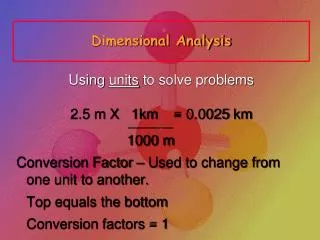
What is dimensional analysis? • Math technique that allows you to use units to solve problems involving measurements • Uses conversion factors • Ratio derived from the equality of two different units that can be used to convert from one unit to another • Example: 4 quarters 1 dollar • They equal one because they are equivalent to each other = 1
How do you do it? • 4 steps • 1. Analyze • 2. Plan • 3. Compute • 4. Evaluate
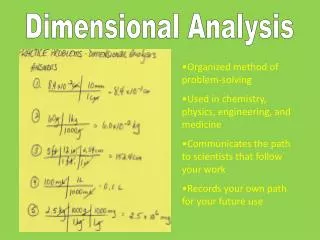
Units are important! • Begin with an idea of what units you will need in your final answer • Keep track of units needed for your unknown quantity • Always check your answer!
How do you do it? • Quantity sought = quantity given x conversion factor • Example: How many quarters in 12 dollars? • Analyze: Given = 12 dollars Unknown = quarters • Plan: The unit given is dollars the unit needed is quarters so the conversion factor must express a relationship: 4 quarters = 1 dollar • Compute: 12 dollars x 4 quarters 1 dollar • Evaluate: Are my units correct? Does the answer make sense? Correct number of sig figs? = 48 quarters
Example 1 • Express a mass of 5.712 grams in milligrams • 5712 mg
Example 2 • 1.2 L = ____ mL 1200 mL
Example 3 • Calculate the volume of a sample of aluminum that has a mass of 3.057 kg. The density of aluminum is 2.70 g/cm3 • V = 1.1 x 103 cm3