Download
1 / 58
580 likes | 694 Vues
This study explores advanced applications of space-time point processes in wildfire forecasting, addressing limitations of existing models such as the Burning Index (BI). We discuss the historical context of Los Angeles County wildfires from 1960 to 2000, analyze previous suppression efforts, and evaluate the effectiveness of traditional BI metrics. Our research introduces a separate point process model, emphasizing the importance of adaptability in predicting wildfire behavior, improving alarm rates, and assessing wildfire risks through innovative techniques.

E N D
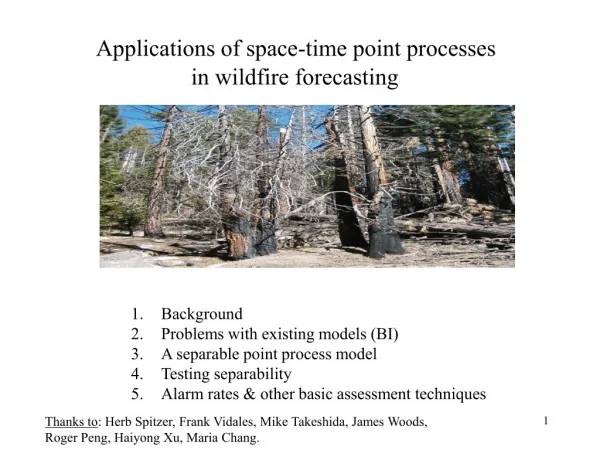
Applications of space-time point processes in wildfire forecasting Background Problems with existing models (BI) A separable point process model Testing separability Alarm rates & other basic assessment techniques Thanks to: Herb Spitzer, Frank Vidales, Mike Takeshida, James Woods, Roger Peng, Haiyong Xu, Maria Chang.
Background • Brief History. • 1907: LA County Fire Dept. • 1953: Serious wildfire suppression. • 1972/1978: National Fire Danger Rating System. (Deeming et al. 1972, Rothermel 1972, Bradshaw et al. 1983) • 1976: Remote Access Weather Stations (RAWS). • Damages. • 2003: 738,000 acres; 3600 homes; 26 lives. (Oct 24 - Nov 2: 700,000 acres; 3300 homes; 20 lives) • Bel Air 1961: 6,000 acres; $30 million. • Clampitt 1970: 107,000 acres; $7.4 million.
NFDRS’s Burning Index (BI): • Uses daily weather variables, drought index, and • vegetation info. Human interactions excluded.
Some BI equations: (From Pyne et al., 1996:) Rate of spread: R = IRx (1 + fw+ fs) / (rbe Qig). Oven-dry bulk density: rb = w0/d. Reaction Intensity: IR = G’ wn h hMhs. Effective heating number: e = exp(-138/s). Optimum reaction velocity: G’ = G’max (b/ bop)A exp[A(1- b / bop)]. Maximum reaction velocity: G’max = s1.5 (495 + 0.0594 s1.5) -1. Optimum packing ratios: bop = 3.348 s -0.8189. A = 133 s -0.7913. Moisture damping coef.: hM = 1 - 259 Mf /Mx + 5.11 (Mf /Mx)2 - 3.52 (Mf /Mx)3. Mineral damping coef.: hs = 0.174 Se-0.19 (max = 1.0). Propagating flux ratio: x = (192 + 0.2595 s)-1 exp[(0.792 + 0.681 s0.5)(b + 0.1)]. Wind factors: sw = CUB (b/bop)-E. C = 7.47 exp(-0.133 s0.55). B = 0.02526 s0.54. E = 0.715 exp(-3.59 x 10⁻⁴ s). Net fuel loading: wn = w0 (1 - ST). Heat of preignition: Qig = 250 + 1116 Mf. Slope factor: fs = 5.275 b -0.3(tan f)2. Packing ratio: b = rb / rp.
On the Predictive Value of Fire Danger Indices: • From Day 1 (05/24/05) of Toronto workshop: • Robert McAlpine: “[DFOSS] works very well.” • David Martell: “To me, they work like a charm.” • Mike Wotton: “The Indices are well-correlated with fuel moisture and fire activity over a wide variety of fuel types.” • Larry Bradshaw: “[BI is a] good characterization of fire season.” • Evidence? • FPI: Haines et al. 1983 Simard 1987 Preisler 2005 Mandallaz and Ye 1997 (Eur/Can), Viegas et al. 1999 (Eur/Can), Garcia Diez et al. 1999 (DFR), Cruz et al. 2003 (Can). • Spread: Rothermel (1991), Turner and Romme (1994), and others.
Some obvious problems with BI: • Too additive: too low when all variables are med/high risk. • Low correlation with wildfire. • Corr(BI, area burned) = 0.09 • Corr(BI, # of fires) = 0.13 • Corr(BI, area per fire) = 0.076 • Corr(date, area burned) = 0.06 • Corr(windspeed, area burned) = 0.159 • Too high in Winter (esp Dec and Jan) • Too low in Fall (esp Sept and Oct)
Some obvious problems with BI: • Too additive: too high for low wind/medium RH, Misses high RH/medium wind. (same for temp/wind). • Low correlation with wildfire. • Corr(BI, area burned) = 0.09 • Corr(BI, # of fires) = 0.13 • Corr(BI, area per fire) = 0.076 • Corr(date, area burned) = 0.06 • Corr(windspeed, area burned) = 0.159 • Too high in Winter (esp Dec and Jan) • Too low in Fall (esp Sept and Oct)
More problems with BI: • Low correlation with wildfire. • Corr(BI, area burned) = 0.09 • Corr(BI, # of fires) = 0.13 • Corr(BI, area per fire) = 0.076 • Corr(date, area burned) = 0.06 • Corr(windspeed, area burned) = 0.159 • Too high in Winter (esp Dec and Jan) • Too low in Fall (esp Sept and Oct)
r = 0.16 (sq m)
More problems with BI: • Low correlation with wildfire. • Corr(BI, area burned) = 0.09 • Corr(BI, # of fires) = 0.13 • Corr(BI, area per fire) = 0.076 • Corr(date, area burned) = 0.06 • Corr(windspeed, area burned) = 0.159 • Too high in Winter (esp Dec and Jan) • Too low in Fall (esp Sept and Oct)
Constructing a Point Process Model as an Alternative to BI…. Definition: A point process N is a Z+-valued random measure N(A) = Number of points in the set A.
More Definitions: • Simple: N({x}) = 0 or 1 for all x, almost surely. (No overlapping pts.) • Orderly: N(t, t+ D)/D ---->p 0, for each t. • Stationary: The joint distribution of {N(A1+u), …, N(Ak+u)} does not depend on u.
Intensities (rates) and Compensators • -------------x-x-----------x----------- ----------x---x--------------x------ • 0 t- t t+ T • Consider the case where the points are observed in time only. • N[t,u] = # of pts between times t and u. • Overall rate: m(t) = limDt -> 0 E{N[t, t+Dt)} / Dt. • Conditional intensity: l(t) = limDt -> 0 E{N[t, t+Dt) | Ht} / Dt, where Ht = history of N for all times before t. • If N is orderly, then l(t) = limDt -> 0 P{N[t, t+Dt) > 0 | Ht} / Dt.
Intensities (rates) and Compensators -------------x-x-----------x----------- ----------x---x--------------x------ 0 t- t t+ T These definitions extend to space and space-time: Conditional intensity: l(t,x) = limDt,Dx -> 0 E{N[t, t+Dt) x Bx,Dx | Ht} / DtDx, where Ht = history of N for all times before t, and Bx,Dx is a ball around x of size Dx. The conditional intensity uniquely characterizes the distribution of a simple process. Suggests modeling l. e.g. Model l(t,x) as a function of BI on day t, interpolating between stations at x1, x2, …, xk using kernel smoothing:
Model Construction • -- Some Important Variables: • Relative Humidity, Windspeed, Precipitation, Aggregated rainfall • over previous 60 days, Temperature, Date. • -- Tapered Pareto size distribution g, smooth spatial background m. l(t,x,a) = b1exp{b2R(t) + b3W(t) + b4P(t)+ b5A(t;60) + b6T(t) + b7[b8 - D(t)]2} m(x) g(a). Two immediate questions: a) How do we fit a model like this? b) How can we test whether a separable model like this is appropriate for this dataset?
Conditional intensity l(t, x1, …, xk; q): [e.g. x1=location, x2 = size.] • Separability for Point Processes: • Say l is multiplicative in mark xj if l(t, x1, …, xk; q) = q0lj(t, xj; qj) l-j(t, x-j; q-j), where x-j = (x1,…,xj-1, xj+1,…,xk), same for q-j and l-j • If l~is multiplicative in xj^ and if one of these holds, then • qj, the partial MLE,= qj, the MLE: • S l-j(t, x-j; q-j) dm-j = g, for all q-j. • S lj(t, xj; qj) dmj = g, for all qj. ^~ • S lj(t, x; q) dm= S lj(t, xj; qj) dmj = g, for all q.
Individual Covariates: • Suppose l is multiplicative, and • lj(t,xj; qj) = f1[X(t,xj); b1] f2[Y(t,xj); b2]. • If H(x,y) = H1(x) H2(y), where for empirical d.f.s H,H1,H2, • and if thelog-likelihood is differentiable w.r.t. b1, • then the partial MLE of b1 = MLE of b1. (Note: not true for additive models!) • Suppose lis multiplicative and the jth component is additive: • lj(t,xj; qj) = f1[X(t,xj); b1] + f2[Y(t,xj); b2]. • If f1 and f2 are continuous and f2 is small: • S f2(Y; b2)2 / f1(X;~b1) dm / T ->p 0], • then the partial MLE b1 is consistent.
Impact • Model building. • Model evaluation / dimension reduction. • Excluded variables.
Model Construction l(t,x,a) = b1exp{b2R(t) + b3W(t) + b4P(t)+ b5A(t;60) + b6T(t) + b7[b8 - D(t)]2} m(x) g(a). Estimating each of these components separately might be somewhat reasonable, as a first attempt at least, if the interactions are not too extreme.
r = 0.16 (sq m)
Testing separability in marked point processes: Construct non-separable and separable kernel estimates of l by smoothing over all coordinates simultaneously or separately. Then compare these two estimates: (Schoenberg 2004) May also consider: S5 = mean absolute difference at the observed points. S6 = maximum absolute difference at observed points.
S3 seems to be most powerful for large-scale non-separability:
r = 0.16 (sq m)
(sq m) (F)
Model Construction • Wildfire incidence seems roughly separable. (only area/date significant in separability test) • Tapered Pareto size distribution f, smooth spatial background m. [*] l(t,x,a) = b1exp{b2R(t) + b3W(t) + b4P(t)+ b5A(t;60) + b6T(t) + b7[b8 - D(t)]2} m(x) g(a). Compare with: [**] l(t,x,a) = b1exp{b2B(t)} m(x) g(a), where B = RH or BI. Relative AICs (Poisson - Model, so higher is better):
One possible problem: human interactions. • …. but BI has been justified for decades based on its correlation with observed large wildfires (Mees & Chase, 1993; Andrews and Bradshaw, 1997). • Towards improved modeling • Time-since-fire (fuel age)
Towards improved modeling • Time-since-fire (fuel age) • Wind direction
Towards improved modeling • Time-since-fire (fuel age) • Wind direction • Land use, greenness, vegetation