Understanding Conditional Probability: Definition, Examples, and Key Concepts
Conditional probability is essential in statistical inference, allowing for the updating of probabilities when certain events occur. This concept helps us determine the updated probability of event A given that event B has occurred. We explore the multiplication rule for conditional probabilities, the law of total probability, and the independence of events. Special attention is given to Bayes’ theorem, which enables the computation of conditional probabilities for disjoint events based on observed events. Various examples illustrate these concepts for clarity.


Understanding Conditional Probability: Definition, Examples, and Key Concepts
E N D
Presentation Transcript
COnDITIONALProbability Onur DOĞAN
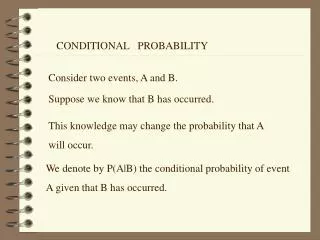
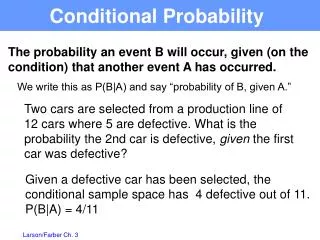
The Definition of Conditional Probability A major use of probability in statistical inference is the updating of probabilitieswhen certain events are observed. The updated probability of event A after welearn that event B has occurred is the conditional probability of A given B.
IndependentEvents If learning that B has occurred does not change the probability of A, then we saythat A and B are independent. There are many cases in which events A and Bare not independent, but they would be independent if we learned that some otherevent C had occurred. In this case, A and B are conditionally independent given C.
Bayes’ Theorem Suppose that we are interested in which of several disjoint events B1, . . . , Bk willoccur and that we will get to observe some other event A. If Pr(A|Bi) is availablefor each i, then Bayes’ theorem is a useful formula for computing the conditionalprobabilities of the Bi events given A.