Understanding Conditional Probability: A Practical Approach
Conditional probability helps us determine the likelihood of an event based on known information about another event. For instance, if we know the individual chosen from a class is female, we can calculate the probability of her being blonde, denoted as P(Blonde | Female). This approach requires using the relevant total that corresponds to the given condition. To grasp conditional probability, remember to consider only the relevant subset of the population and reference examples like the blonde female scenario to reinforce your understanding and confidence in solving these types of problems.

Understanding Conditional Probability: A Practical Approach
E N D
Presentation Transcript
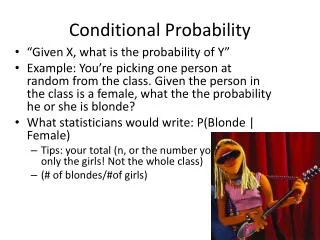
Conditional Probability • “Given X, what is the probability of Y” • Example: You’re picking one person at random from the class. Given the person in the class is a female, what the the probability he or she is blonde? • What statisticians would write: P(Blonde | Female) • Tips: your total (n, or the number you divide by is only the girls! Not the whole class) • (# of blondes/#of girls)
From your pset! • Given your cloth is from a hand loom, what is the probability • that the quality is poor? • Locate Handloom cloth • How many total pieces are there made by a hand loom? • How many of those are of poor quality?
Hints for solving Probability word problems • When there is already a table, diagramming a tree is unnecessary • Be careful to take the right total (n, denominator) • Especially in conditional probabilities! • The simplest example of a conditional probability is the blonde | woman example we did above, store that in your head for easy reference, and so you’re not intimidated by the “ | “