Basic Character Input and Output in C Programming
180 likes | 300 Vues
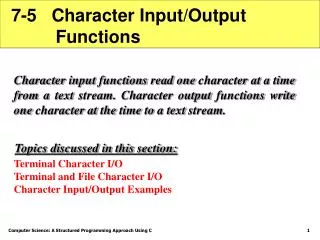
This lecture covers the fundamentals of character input and output in C programming, including standard input/output functions, basic data types, and control structures. We will explore multiple examples demonstrating how to read and write characters using functions like `getchar()` and `putchar()`. Additionally, we will implement character and line counting programs. Key concepts will include the usage of arrays for counting specific characters and an understanding of how arrays work in terms of pointers. This content is essential for beginners looking to deepen their knowledge of C programming techniques.


Basic Character Input and Output in C Programming
E N D
Presentation Transcript
Character Input and Output C and Data Structures Baojian Hua bjhua@ustc.edu.cn
Overview • We have talked about: • Basic data types and C control structures • This lecture: • Basic character input and output • Three examples: • echo input directly to output • character counting • line counting
Char IO • Including the Standard Input/Output (stdio) library • #include <stdio.h> • Makes names of functions, variables, and macros available • Defining procedure main() • Starting point of the program, a standard boilerplate • Read a single character • Returns a single character from the text stream “standard in” (stdin) • char c = getchar(); • Write a single character • Writes a single character to “standard out” (stdout) • putchar (c);
The Code #include <stdio.h> int main(void) { int c; c = getchar(); putchar(c); return 0; }
self-increment operator Read Ten Chars #include <stdio.h> int main(void) { int c; int i; for (i=0; i<10; i++) { c = getchar(); putchar(c); } return 0; }
Infinite IO #include <stdio.h> int main(void) { int c; int i; for ( ; ; ) { c = getchar(); putchar(c); } return 0; } // or a while version #include <stdio.h> int main(void) { int c; int i; while (1) { c = getchar(); putchar(c); } return 0; }
Conditional IO #include <stdio.h> int main(void) { int c; int i; c = getchar(); while (c != ‘a’) { c = getchar(); putchar(c); } return 0; }
Character Counting #include <stdio.h> /* count characters in input */ int main() { long nc; nc = 0; while (getchar() != EOF) { ++nc; } printf("%ld\n", nc); return 0; }
Line Counting #include <stdio.h> /* count lines in input */ int main() { long numLines; numLines = 0; char c; while ((c=getchar()) != EOF) { if (c == ‘\n’) ++numLines; } printf("%ld\n", numLines); return 0; }
Arrays • Thus far, we have seen: • Characters are just small integers (0-255) • More operations • ++i, i++, ==, != • Control structures • Nested controls • Next, we consider how to count the number of characters ‘0’ to ‘9’
A First Try #include <stdio.h> int main() { long num0, num1, …, num9; num0 = num1 = … = num9 = 0; char c; while ((c=getchar()) != EOF) { if (c == ‘0’) ++num0; else if (c == ‘1’) ++num1; …; } printf("%ld\n", …); return 0; }
Using Arrays #include <stdio.h> int main() { long num[10]; char c; int i; for (i=0; i<10; i++) num[i] = 0; while ((c=getchar()) != EOF) { if ((c >= ‘0’) && (c <= ‘9’)) ++num[c-’0’]; } return 0; }
The Essence of Array • An array variable a is just a pointer pointing to the first array element a[0] • So when we pass an array to other functions, or we operate on the array variable, we are really operating on a pointer, not on array elements • More on this later
An Example #include <stdio.h> void foo(long[] a) { a[0] = 999; return; } int main() { long num[5]; num[0] = 0; foo (num); printf(“%ld\n”, num[0]); return 0; } ? ? num ? ? ?
An Example #include <stdio.h> void foo(long[] a) { a[0] = 999; return; } int main() { long num[5]; num[0] = 0; foo (num); printf(“%ld\n”, num[0]); return 0; } 0 ? num ? ? ?
An Example #include <stdio.h> void foo(long[] a) { a[0] = 999; return; } int main() { long num[5]; num[0] = 0; foo (num); printf(“%ld\n”, num[0]); return 0; } a 0 ? num ? ? ?
An Example #include <stdio.h> void foo(long[] a) { a[0] = 999; return; } int main() { long num[5]; num[0] = 0; foo (num); printf(“%ld\n”, num[0]); return 0; } a 999 ? num ? ? ?
An Example #include <stdio.h> void foo(long[] a) { a[0] = 999; return; } int main() { long num[5]; num[0] = 0; foo (num); printf(“%ld\n”, num[0]); return 0; } 999 ? num ? ? ?