Cell ( E. coli ) down (maximum speed for 30 seconds)
30 likes | 163 Vues
Cell ( E. coli ) down (maximum speed for 30 seconds). supernatant (medium) bacterial pellet. Alkaline lysis solution I (100 µl)-vigorously vortexing. Alkaline lysis solution II (200 µl)-inverting five times


Cell ( E. coli ) down (maximum speed for 30 seconds)
E N D
Presentation Transcript
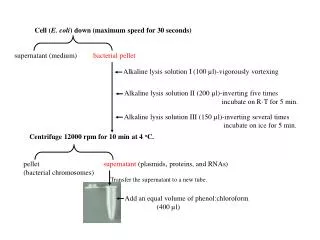
Cell (E. coli) down (maximum speed for 30 seconds) supernatant (medium) bacterial pellet Alkaline lysis solution I (100 µl)-vigorously vortexing Alkaline lysis solution II (200 µl)-inverting five times incubate on R·T for 5 min. Alkaline lysis solution III (150 µl)-inverting several times incubate on ice for 5 min. Centrifuge 12000 rpm for 10 min at 4 oC. pellet supernatant (plasmids, proteins, and RNAs) (bacterial chromosomes) Transfer the supernatant to a new tube. Add an equal volume of phenol:chloroform (400 µl)
Aqueous upper layer (plasmids and RNAs) Phenol:chloroform (proteins) maximum speed for 2 min Transfer the 400 µl of aqueous upper layer to a new tube *Ethanol precipitation Add 0.1 vol Sodium acetate (0.3 M, pH 5.2) of sample volume (40 µl) 2.5 vol 100 % Ethanol of sample volume (1000 µl)
Centrifuge 12000 rpm for 10 min at 4 oC. supernatant (ethanol) pellet (plasmids and RNAs)) Add 70 % ethanol for washing the pellet Spin down (remove the rest of 70 % ethanol.) To eliminate the ethanol perfectly, dry the pellet for 10 min Dissolve the pellet in 30 µl of TE buffer(or ddH2O) containing RNase A