
The Impact of Tobacco on Social Justice and Poverty in Low-Income Countries

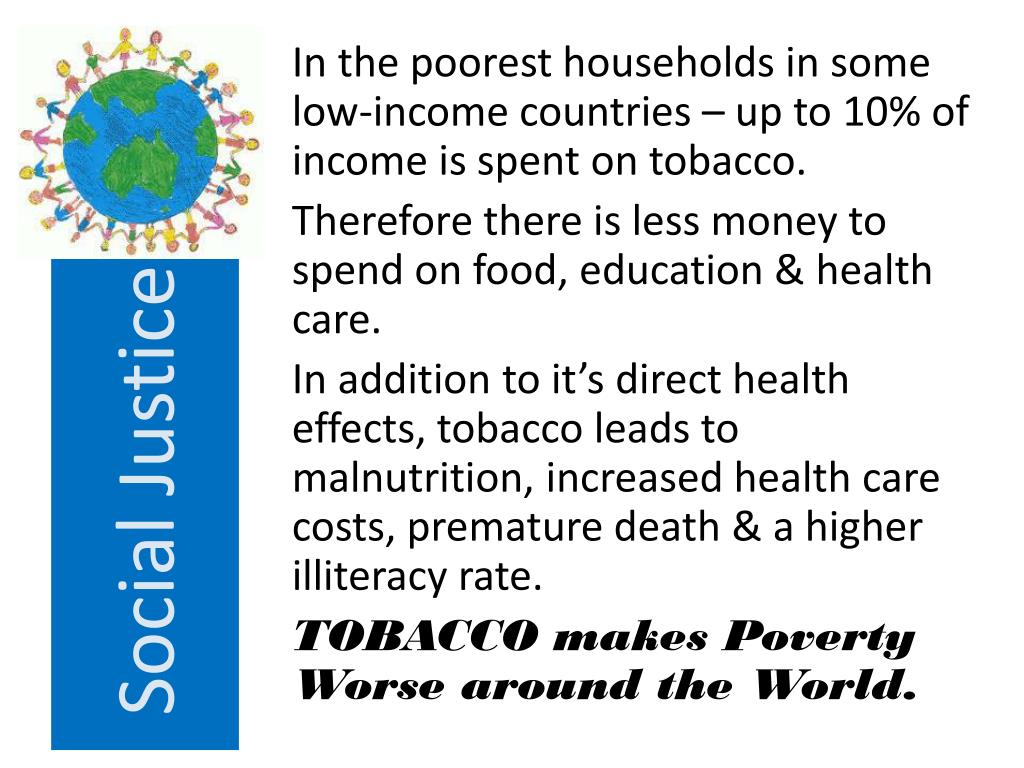
In low-income countries, up to 10% of household income is spent on tobacco, diverting funds away from essential needs like food, education, and healthcare. Tobacco use not only contributes to health issues but exacerbates malnutrition, increases healthcare costs, and leads to premature deaths and higher illiteracy rates. The reliance on child labor for tobacco cultivation inflicts additional harm, subjecting young workers to pesticide poisoning and nicotine absorption. With 84% of smokers residing in developing economies, the tobacco epidemic hinders economic productivity and family stability.
Télécharger la présentation 
Politique de téléchargement : le contenu du site vous est fourni TEL QUEL pour votre information et votre usage personnel ; il ne peut être vendu, concédé sous licence ni partagé sur d’autres sites sans l’accord de son auteur.Le contenu vous est fourni TEL QUEL, pour votre information et votre usage personnel uniquement. Téléchargez la présentation en cliquant sur ce lien. Lors du téléchargement, si vous ne parvenez pas à télécharger une présentation, l’éditeur a peut-être supprimé le fichier de son serveur.Pendant le téléchargement, si vous ne parvenez pas à obtenir une présentation, le fichier a peut-être été supprimé par l’éditeur.
F I N