Navigating Successful School Transitions
150 likes | 174 Vues
Explore essential elements for smooth transitions between schools and stages of education for children with Down's Syndrome, offering practical advice and support for families and educators.


Navigating Successful School Transitions
E N D
Presentation Transcript
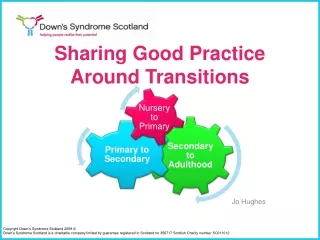
Sharing Good Practice Around Transitions Jo Hughes
The Essential Elements for a Successful Transition • A positive attitude from receiving school. • A carefully prepared transition plan. • A timeous strategy for implementation.
“It would be fair to say we were a little apprehensive about him starting. We had never had a child with Ds in our school, we didn’t know what to expect and whether we had the skills to teach him…” “I wish teachers would be honest, I don’t mind that they aren’t sure, I just want them to be willing to try………”
Pre School Choices At age 2 begin planning………. • Which school, what pre school provision do they have? • Where do siblings go? • What additional support is needed? • Get support in place early, build relationships, • Can the nursery and school staff work closely together for the future Age 3 – nursery/ how will they be ready for school /specialist input Age 4 – what about deferment???
Nursery to Primary School • What additional support is needed? • Get support in place early ideally begin the year before • Build relationships, can the nursery and school staff work closely together • Utilising other professionals • Staff training – understanding the child’s learning profile • Lot’s of visits – photographs, book for child to take home • Make the environment visual • Build in routine • Boundaries and relationships • Communication passport Don’t forget about those yearly transitions!!!!!!
Transition: “a change from one thing to another” such as: • School terms • School years • Teachers/support staff/ pupils/ people • Environment • Routines • Family These are all changes that can be difficult
Primary 6 Begin planning now by: • Visiting and choosing a secondary school • Involving secondary school: Additional Support for Learning Staff • Utilising other professionals • Thinking about further independence skills that can be developed whilst still at primary • Having a plan in place by the end of P6 • Beginning to think about support hours/support required • Communication passort
Primary 7 – A time of Transition The work begins: • Identify key staff – get support in place before August • Lot’s of visits: two way and remember non class time visits are just as important • Don’t miss out on P7 experiences it’s a rite of passage… • Buddies and Friends • Take a camera- Photographs, • Training for all staff at secondary including subject specialists • Timetable preparation – colour coded, pictures/symbols • Maps of the school – map reading skills • Differentiation – give yourselves a head start Involve the Young Person
Leaving School Must begin 18 months before school leaving age! • Accreditation for learning • Think about action steps to greater independence • Education is about all four capacities • Think about Person Centred Planning or similar approaches as a tool for involvement and planning • Involve all the important people; especially the young person and their family
Principles of Good Transitions 2 • All plans and assessments should be made in a person centred way • Support should be co-ordinated across all services • Planning should start early and continue up to age 25 • Young people should get the support they need • Young people, parents and carers must have access to the information they need • Families and carers need support • Legislation and policy should be co-ordinated and simplified
Leaving School cont. • Find out what’s out there – get help!! • Bring in adult services/transition teams they are the budget holders for future support. • Get a plan • Monitor it closely • Keep everyone on track
Useful Links • whataboutus.org.uk • scottishtransitions.org.uk • skillsdevelopmentscotland.co.uk • enquire.org.uk • gov.scot.\getting it right for every child • Cerebra.org.uk • communicationpassports.org.uk
Any questions? Jo Hughes | Senior Family Support Service Officer Mob: 07590 047 472 | 01563 533473 E: jo@dsscotland.org.uk Down’s Syndrome Scotland, Riverside House, 502 Gorgie Road, Edinburgh. EH11 3AF T: 0131 442 8840 | www.dsscotland.org.uk