
1 / 4

CP Violation in Particle Decay: Amplitude and Phase Analysis

This document explores solutions for exercises related to CP violation. It highlights key concepts such as total amplitude and phase differences in particle decays. The total amplitude |A+B| in Exercise 7 and its significance in observing CP violation are discussed, particularly when additional phases are introduced. Exercise 8 examines the decay diagrams for B0 and B0 mesons and shows how CP operations affect these states, emphasizing the importance of phase relationships in determining CP violation. The results point to the necessity of both CP-violating and CP-invariant phases.
Télécharger la présentation

CP Violation in Particle Decay: Amplitude and Phase Analysis

An Image/Link below is provided (as is) to download presentation Download Policy: Content on the Website is provided to you AS IS for your information and personal use and may not be sold / licensed / shared on other websites without getting consent from its author. Content is provided to you AS IS for your information and personal use only. Download presentation by click this link. While downloading, if for some reason you are not able to download a presentation, the publisher may have deleted the file from their server. During download, if you can't get a presentation, the file might be deleted by the publisher.

E N D

Presentation Transcript


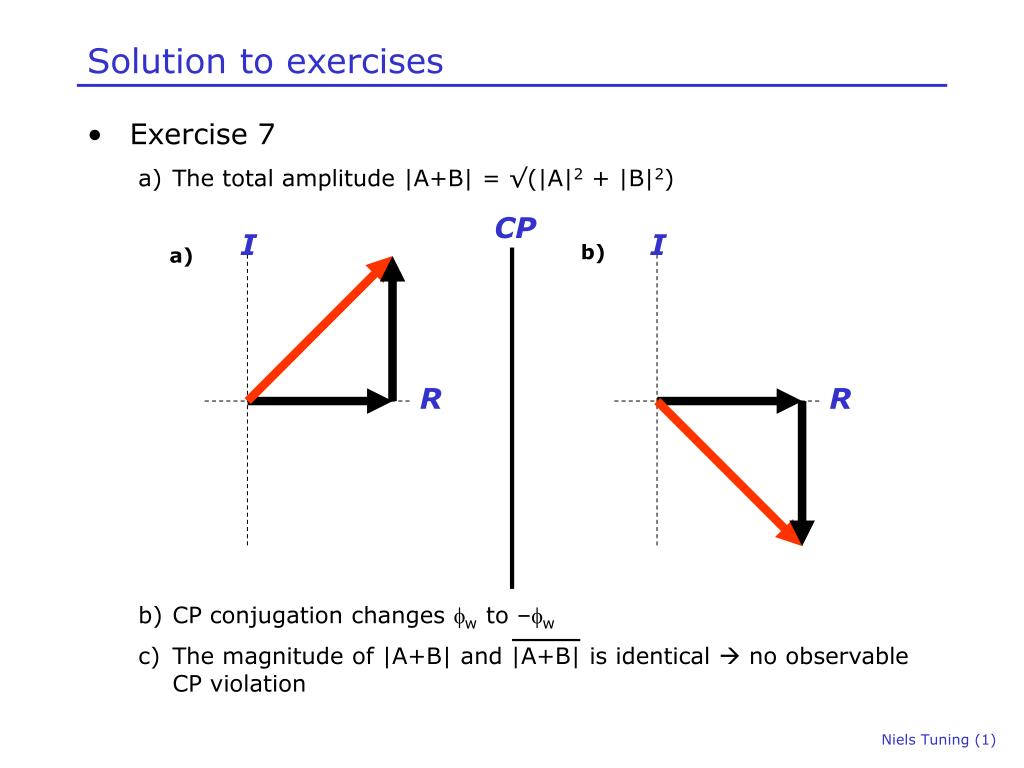
  1. Solution to exercises • Exercise 7 • The total amplitude |A+B| = √(|A|2 + |B|2) • CP conjugation changes fw to –fw • The magnitude of |A+B| and |A+B| is identical  no observable CP violation CP I I b) a) R R Niels Tuning (1)

  2. Solution to exercises • Exercise 7 (continued) • Repeat of exercise with 45o additional strong phase • Amplitude |A+B| and |A+B| now different  observable CP violation. Conclusion: you need both a CP violating and a CP invariant phase to observe CP violation CP I I B +fw fs fs R R A -fw Phase difference between A and B: φs+φw Phase difference between A and B: φs-φw φs+φw=90+45=135 Φs-φw=90-45=45 Niels Tuning (2)

  3. Solution to exercises • Exercise 8 • The decay diagram for B0 and B0 • The P operation interchanges the p+ and the p-. The C operation changes each p+ in a p- and vice versa, thus CP(p+p-) = C(p-p+) = p+p-. Therefore p+p- is an eigenstate of CP • The direct decay of the B0 proceeds to the left diagram above. The decay through mixing of the B0 proceeds through the right decay diagram above preceded by a B0/B0bar mixing diagram d d Vud Vud* u u Vub* Vub u u b b d d d d Niels Tuning (3)

  4. Solution to exercises • Exercise 8 (continued) • The direct decay has a phase –g (because it has Vub*). The decay via mixing has phase 2b (from mixing) plus a phase g (because it has Vub) adding up to 2b+g. The net phase difference is therefore 2b+g-(-g) = 2b+2g • The three angles of the unitarity triangle are a,b,g. Since in a triangle a+b+g=p by construction, you find that 2b+2g=-2a+2p=-2a Niels Tuning (4)

More Related