Understanding Reproduction and Development: A Deep Dive into Biological Processes
This educational resource explores the essential concepts of reproduction and development, highlighting key differences between asexual and sexual reproduction. It includes a look at genetic disorders like Crouzon syndrome and primordial dwarfism through the stories of individuals like Petero and Kenadie. The text delves into chromosomes, karyotypes, and the cell cycle, explaining the phases of mitosis and meiosis, as well as various asexual reproduction methods. This comprehensive guide aims to enhance understanding of genetic inheritance and cellular processes.

Understanding Reproduction and Development: A Deep Dive into Biological Processes
E N D
Presentation Transcript
Reproduction and Development What is reproduction?
Anticipatory Set • Please meet: • Petero (from Uganda) • And • Kenadie!!! • What do they have in common??
Crouzon Syndromegenetic disorder, skull bones fuse, 1-25,000 are affected • *
Meet Kenadie! • Kenadie 3yrs.old • Tyran 18mths. • Primodial • dwarfism
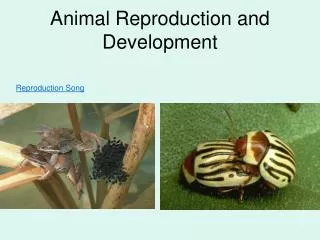
Reproduction • To make more of its own kind: • A) asexual – 1 parent, identical offspring • B) sexual – 2 parents, NOT identical offspring
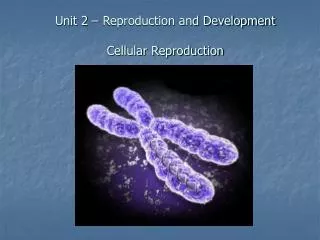
What is a chromosome? • Contains genetic information • Made of genes which are made of DNA • Chr. genes DNA • Let’s look at the structure: chromatid, centromere, double stranded chromosome
HOMOLOGOUS CHROMOSOMEthe same shape and size carry genes for same traits
What is Mitosis? • Cell division by nuclear duplication (exact copy) and cytoplasmic division • Occurs through phases….
What are the phases (stages) of mitosis? • Interphase: (not considered the first phase) • Resting stage • Chromosomes duplicate • Growth • Longest phase
Prophase • Nuclear membrane begins to disappear • Nucleolus disappears • Spindle fibers begin to • form • Chromosome visible • Under microscope!
Metaphase • Chromosomes line up in middle • Spindle fibers attach • Centrioles on opposite ends (centrioles not present in plant • Cell!
Anaphase • Chromosomes separate • Centromere duplicate • Spindle fibers shorten
Telophase • Membrane begins to pinch in • Cytoplasm divides • Daughter cells form (identical) • Reappearance of nuclear membrane, centrosome, etc.
Cytokinesis • Cytoplasm divides forming the cleavage furrow. • Plant cell forms cell plate only!
mitosis • *
Plant cell mitosis • Identify the parts…
Difference in Plants • NO CENTRIOLES • FORMS CELL PLATE!!
Meiosis • What is meiosis? • Why do we need to learn about it??
Meisosis • !
What are the different forms of asexual reproduction? • 1. binary fission • 2. budding • 3. spore formation • 4. regeneration • 5. vegetative propagation
Binary Fission • Equal division • A) paramecium • B) ameba
Budding • Unequal cytoplasmic division • A) yeast • B) hydra • Produces many buds • Also reproduces sexually
Sporulation • Spore formation • A) bread mold • Spores: released by parent, good condition the develop, protective wall to prevent drying of protoplasm • Hypha, mycelium (spores), rhizoids
Bread Mold • YUM!!
Regeneration • Growing back of missing parts • A) starfish • B) planaria (flatworm (we can’t regenerate due to “differentiated cells”) ex: we can’t grow a finger back!
Starfish Regeneration • OUCH!
Vegetative Propagation • Type of regeneration in plants from roots, stems or leaves • A) Natural Vegetative Propagation • 1. bulbs – onions, raddish (roots) • 2. tubers – potatoes (stems) • 3. runners – strawberries, ivy
Artificial Vegetative Propagation • 1. cuttings • 2. grafting