Unlocking Room Temperature Superconductivity: Insights from Paul M. Grant's Research
230 likes | 367 Vues
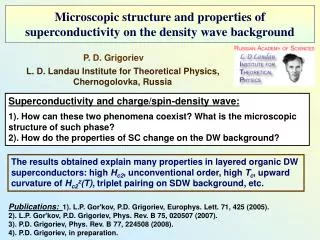
This presentation by Paul M. Grant, a Visiting Scholar at Stanford and a retired IBM Research Staff Member, delves into the complexities of achieving room temperature superconductivity. The discussion covers the theoretical foundations, including exciton interactions and electron behavior in materials, drawing on historical insights and recent advancements. The event, held in Loen, Norway from June 17-22, 2007, highlights Grant's pioneering work and the potential implications for future technologies, offering a comprehensive overview of the quest for practical superconductors at ambient temperatures.


Unlocking Room Temperature Superconductivity: Insights from Paul M. Grant's Research
E N D
Presentation Transcript
Does the Hold the Key to Room Temperature Superconductivity? Paul M. Grant Visiting Scholar, Stanford IBM Research Staff Member Emeritus EPRI Science Fellow (Retired) Principal, W2AGZ Technologies The Road to Room Temperature Superconductivity Loen, Norway 17-22 June 2007 http://www.w2agz.com/rtsc07.htm
- - + + - - + + - - + + Diethyl-cyanine iodide Little, 1963
“Bill Little’s BCS” • Where • = Exciton Characteristic Temperature (~ 22,000 K) • = Fermion-Boson Coupling Constant (~ 0.2) * = Fermion-Fermion Repulsion (?) a = “Gap Parameter, ~ 1-3” Tc = Critical Temperature, ~ 300 K
False Alarm: Spine is a Semiconductor!
Electron-Exciton Interaction Exciton c-a Operators Electron-Exciton Coupling
“Not So Famous Danish Kid Brother” Harald Bohr Silver Medal, Danish Football Team, 1908 Olympic Games
Almost Periodic Functions “Electronic Structure of Disordered Solids and Almost Periodic Functions,” P. M. Grant, BAPS 18, 333 (1973, San Diego)
APF “Band Structure” “Electronic Structure of Disordered Solids and Almost Periodic Functions,” P. M. Grant, BAPS 18, 333 (1973, San Diego)
Fibonacci Chains “Monte-Carlo Simulation of Fermions on Quasiperiodic Chains,” P. M. Grant, BAPS March Meeting (1992, Indianapolis)