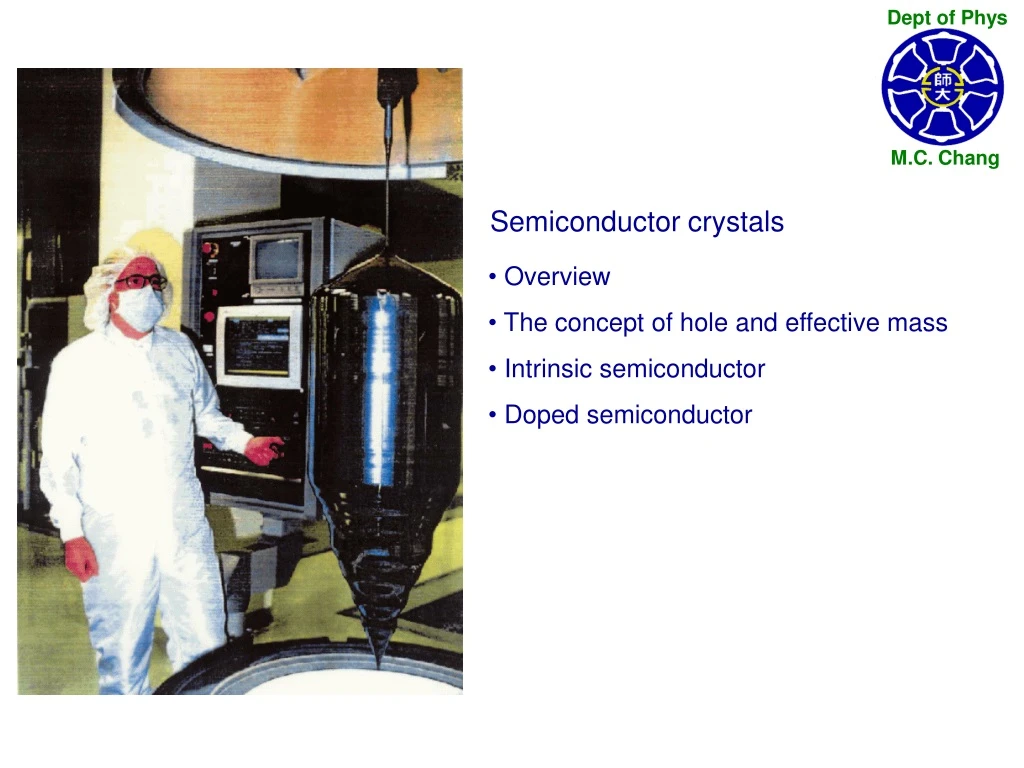

Semiconductor Crystals: Overview of Hole Concept and Effective Mass
E N D
Presentation Transcript
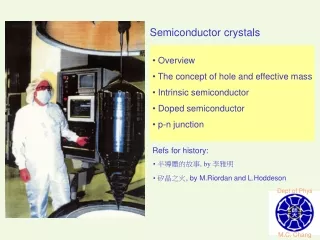
Dept of Phys M.C. Chang Semiconductor crystals • Overview • The concept of hole and effective mass • Intrinsic semiconductor • Doped semiconductor
Families of semiconductors • Elements • Compounds Bonding becomes more ionic
Basic properties • (at 300K) Ge Si GaAs GaN • energy gap (eV) 0.67 (i) 1.11 (i) 1.43 (d) 3.39 (d) • lattice type Diamond Diamond Zincblend Wurtzite 2 overlapping hcp lattices • Semiconductor is insulator at 0 K, but because of its smaller energy gap (insulator diamond = 5.4 eV), electrons can be thermally excited to the conduction band (and transport current) easily. • Si-based device can endure higher working temperature than Ge-based (75 oC) device ( Si has a larger band gap). For some interesting history of semiconductor industry, see • 矽晶之火, by M.Riordan and L.Hoddeson.
Direct band gap (GaAs, GaN…) • Indirect band gap (Si, Ge…) =Eg =Eg+ • Direct band gap semiconductor can emit light efficiently (1μm=1.24 eV)
A filled band does not carry current (Peierls, 1929) • Electric current density • For crystals with inversion symmetry, • εn(k)= εn(-k) • → electrons with momenta ħk and -ħk have opposite velocities • →no net current in equilibrium A nearly-filled band • ∴ unoccupied states behave as +e charge carriers
The concept of hole (Peierls, 1929) • If an electron of wavevector ke is missing, then k= -ke. Alternatively speaking, a hole with wavevector kh is produced (and kh= -ke). • The lower in energy the missing electron lies, the higher the energy of the whole system. If the energy of a filled valence band is set to zero, then h The missing electron k
important Effective mass Near the bottom of a conduction band, the energy dispersion is approximately parabolic, Effective mass matrix The electron near band bottom is like a free electron (with m*). • For a spherical FS, m*ij=m*δij, only one m* is enough. • In general, electron in a flatter band has a larger m*. • Negative effective mass: • If ε(k) is (e.g. top of valence band), then m*<0 • electron (-e) with negative m* = hole (+e) with positive m*.
T L • For ellipsoidal FS, there can be at most three different m*s Eg. the FS of Si is made of six identical ellipsoidal pockets. • For Si, εg = 1.1 eV, mL= 0.9 m, mT= 0.2 m (It’s more difficult for the electron to move along L. The mass is larger because the band is flatter along that direction.)
Some useful parameters mL /mT mHH/mLH Δ Si0.91/0.19 0.46/0.16 0.044 eV GaAs 0.063 0.5/0.076 0.3 eV More band structures and Fermi surfaces Common features
Overview The concept of hole and effective mass Intrinsic semiconductor (no doping) Doped semiconductor
DOS and carrier density • DOS for free electron (ch 6) • DOS (per V) for semicond • Fermi distribution • carrier density Top of valence band is set as ε=0
Consider the “non-degenerate” case: For electrons,ε-μ >> kBT For holes, μ- ε>> kBT • electron density in conduction band: • hole density in valence band: Valid even with doping
Carrier density and energy gap In intrinsic semiconductor, • Chemical potential • The density of intrinsic carriers depends only on the energy gap. The 2nd term is very small because kBT<<EG (For Si, the atom density is 5×1022cm-3.)
Impurity level: Bohr atom model • The ionized impurity atom has a hydrogen-like potential, • (m →me, ε0→ ε) • Dielectric constant of Si = 11.7 (Ge=15.8, GaAs=13.13), • Effective mass for Si = 0.2 m. • Therefore, the donor ionization energy = 20 meV. • Bohr radius of the donor electron: • For Si, it's about 50 A (justifies the use of a constant ε).
Impurity levels in Si Conduction band Valence band • Energy-band point of view
Solid state lighting From S. Nakamura’s slide
After See a nice “Interview with Nakamura”: Scientific American, July, 2000 The invention of blue-light LED GaN can emit blue light because of its large band gap (3.4 eV). • First blue-light LED: Shuji Nakamura 1989. • First blue-light laser: Shuji Nakamura 1997. 中村修二 Before 2006
LED-backlit LCD TV Blade runner (1982) Kerosene lighting and firewood are used by 1/3 of the world; they cause countless fires and are very inefficient. UV Water Purifier