Audition
This overview explores the complex mechanics of hearing, taste, smell, and the skin senses. It delves into auditory elements like amplitude, pitch, and timbre, highlighting key anatomical structures such as the cochlea and tympanic membrane. Theories of hearing, including the Place and Frequency theories, provide insight into how we perceive sound. Additionally, the document examines the chemical senses of taste and olfaction, explaining how specialized receptors process stimuli. It also touches on kinesthetic and vestibular senses, underlining their roles in body awareness and spatial orientation.


Audition
E N D
Presentation Transcript
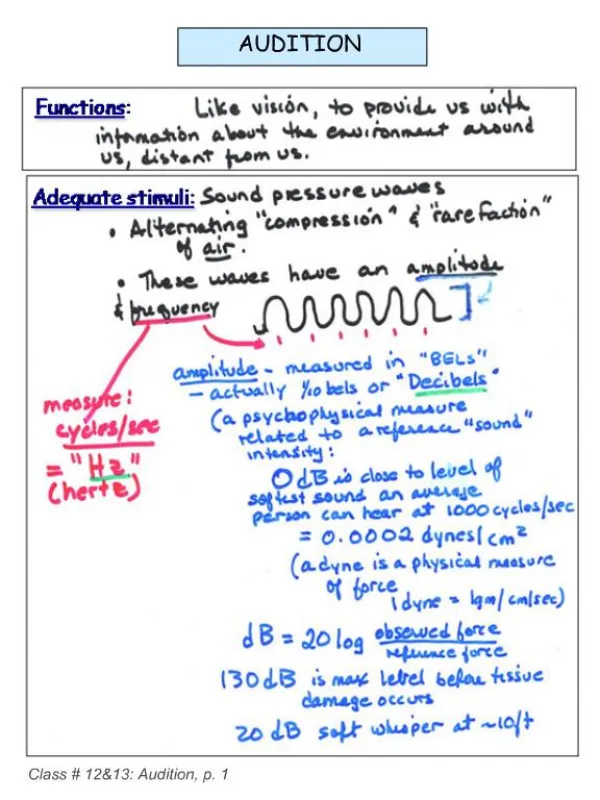
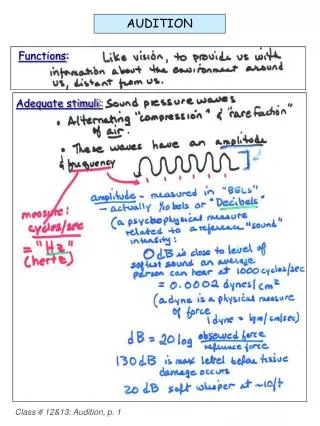
Mechanics • Amplitude: intensity (loudness) • Pitch: tone (high pitch vs. low pitch) • Timbre: quality of sound
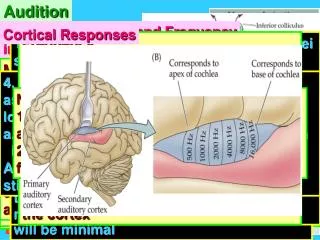
Hearing • Auditory Canal • Tympanic membrane • Malleus, Incus, Stapes • Oval Window • Cochlea
Theories of Hearing • Place Theory (Helmholtz) • Pitch is determined by what part of the basilar membrane is stimulated • Frequency Theory • Basilar membrane fires the same frequency as sound • (volley principle--explains how higher frequencies are produced) • Duplicity Theory • Sounds are heard by combination of place and frequency
Taste • Chemical Sense • Papillae on tongue are specialized for different chemicals • Now 5 • Salt • Sour • Bitter • Sweet • Umami
Olfaction Stinks! • Chemical Sense • Direct path to brain • Olfactory epithelium has specialized receptors; take chemical energy from odors and converts to electrochemical
Skin Sense • Haptic--pressure, temperature, pain • Pressure--shallow and deep • Temperature--warm and cold fibers • Pain
Kinesthesis Body sense Tells us where our parts are Skeletal
Vestibular • Vestibular sacs and semicircular canals hold fluid • Motion moves hairs in fluid • Acts like gyroscope