Download
1 / 13
130 likes | 239 Vues
This text explores the concept of phenotype and its influences, detailing incomplete dominance, where heterozygous phenotypes are intermediate, and codominance, where both alleles are expressed equally. Examples like ABO blood types and sickle cell disorder illustrate these genetic interactions. Additionally, it discusses multiple alleles and polygenic traits, emphasizing how various genetic and environmental factors affect phenotypic expression, such as height and color variations. This comprehensive overview is essential for understanding inheritance patterns and their implications.

E N D
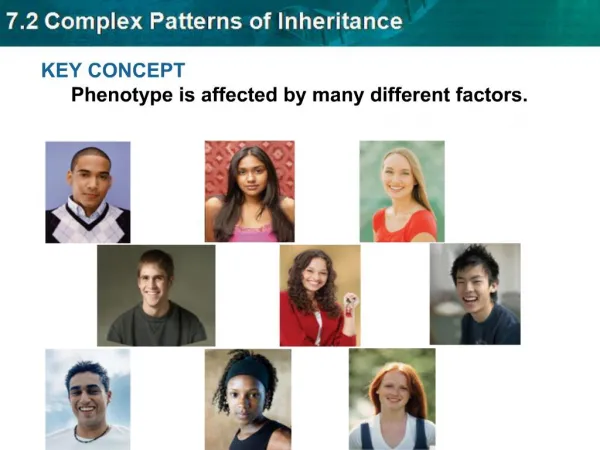
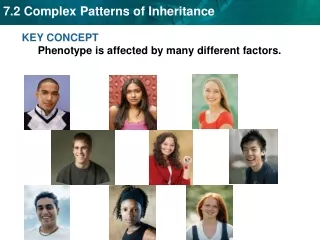
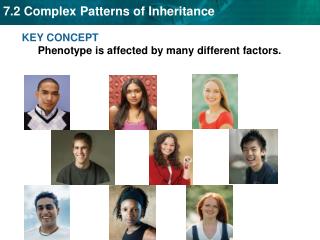
KEY CONCEPT Phenotype is affected by many different factors.
In (3.)incomplete dominance, (AKA- intermediate dominance) neither allele is completely dominant nor completely recessive. • Heterozygous phenotype is intermediate between the two homozygous phenotypes • Use capital letters and apostrophes’ • RR-red homozygous dominant • RR’-pink heterozygote is intermediate • R’R’-white homozygous recessive
Phenotype can depend on interactions of alleles. • In (3.)incomplete dominance, neither allele is completely dominant nor completely recessive. • Heterozygous phenotype is intermediate between the two homozygous phenotypes • Homozygous parental phenotypes not seen in F1 offspring • B1B1 GreenB2B2 blueB1B2 royal blue
Codominant alleles are neither dominant nor recessive. • Ex. The ABO blood types result from codominant alleles. • Ex. Sickle cell disorder • RR- normal red blood cell shape • RS-sickle cell trait- carrier • SS-sickle cell anemia • (4)Codominant –equal expression of both alleles.
Genetic disorder- • Hemoglobin- a protein in Red Blood Cells that carry oxygen to body cells • Sickle cell anemia-a genetic disorder that causes a change in the shape of red blood cells • Sickle cell Trait-some normal, some sickle shaped cells
(5) multiple alleles • Traits that are controlled by more than 2 alleles, although only two alleles exist in a diploid cell. • Example- Human Blood Types-each person inherits two alleles, one from each parent, but three exist in the human “gene pool”. 4 blood types3 alleles • Type-A IAIA, IAi A is dom. to O • Type-B IBIB, IBi B is dom. To O • Type-AB IAIB AB are codominant • Type-O ii recessive • This is determined by the shape of proteins on red blood cells and by the presence or absence of plasma antigens. O universal donor-AB universal receiver.
Order of dominance: brown > green > blue. (6)Polygenic -many genes may interact to produce one trait. The genes may be on the same or on a different chromosome.Result in a wide rangeof variation.Ex. Hair color, height eye color
Often compared to a bell curve • AA,BB,CC highest range • aa.bb.cc lowest range • Aa,Bb,Cc middle
Other factors of gene expression Phenotype is a combination of genotype and environment. • External environment- • temperature, nutrition, • light • Internal factors: different • hormones, structures, and • effects of aging. Ex.The sex of sea turtles depends on both genes and the environment-(temperature of the nest) • Ex.Height is an example of a phenotype strongly affected by the environment.