Efficient Modeling Protocol for Groundwater Systems
Explore the comprehensive modeling protocol for groundwater systems, from developing conceptual models to calibration and verification techniques. Learn about the purpose of models, calibration sensitivity analysis, predictive sensitivities, and ethical considerations. Enhance your understanding of how to design effective models and present results for optimal decision-making.

Efficient Modeling Protocol for Groundwater Systems
E N D
Presentation Transcript
What is a “model”? • Any “device” that represents approximation to field system • Physical Models • Mathematical Models • Analytical • Numerical CJM
Modeling Protocol • Establish the Purpose of the Model • Develop Conceptual Model of the System • Select Governing Equations and Computer Code • Model Design • Calibration CJM
Modeling Protocol • Calibration Sensitivity Analysis • Model Verification • Prediction • Predictive Sensitivity Analysis • Presentation of Modeling Design and Results • Post Audit • Model Redesign CJM
Purpose - What questions do you want the model to answer? • Prediction; System Interpretation; Generic Modeling • What do you want to learn from the model? • Is a modeling exercise the best way to answer the question? Historical data? • Can an analytical model provide the answer? System Interpretation: Inverse Modeling: Sensitivity Analysis Generic: Response to Tidal Influences CJM
Model “Overkill”? • Is the vast labor of characterizing the system, combined with the vast labor of analyzing it, disproportionate to the benefits that follow? • EXAMPLE: Siting study for a residential community….one of the potential sites has some pre-existing contamination. You could complete a full-blown model of the site ($1 Mill) to learn that it is an unlikely candidate. CJM
ETHICS • There may be a cheaper, more effective approach • Warn of limitations CJM
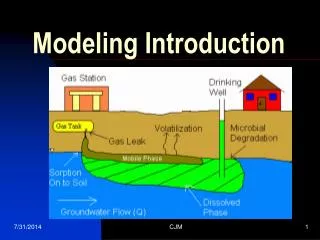
Conceptual Model“Everything should be made as simple as possible, but not simpler.” Albert Einstein • Pictoral representation of the groundwater flow system • Will set the dimensions of the model and the design of the grid • “Parsimony”….conceptual model has been simplified as much as possible yet retains enough complexity so that it adequately reproduces system behavior. CJM
Select Governing Equation Steady/Unsteady..1, 2, or 3-D; …Heterogeneous/Isotropic…..Instantaneous/Continuous • Select Computer Model • Code Verification • Comparison to Analytical Solutions; Other Numerical Models • Model Design • Design of Grid, selecting time steps, boundary and initial conditions, parameter data set CJM
Calibration • Show that Model can reproduce field-measured heads and flow (concentrations if cont. transport) • Results in parameter data set that best represents field-measured conditions. CJM
Calibration Sensitivity Analysis • Uncertainty in Input Conditions • Determine Effect of Uncertainty on Calibrated Model CJM
Model Verification • Use Model to Reproduce a Second Set of Field Data Prediction • Desired Set of Conditions • Sensitivity Analysis • Effect of uncertainty in parameter values and future stresses on the predicted solution CJM
Presentation of Modeling Design and Results • Effective Communication of Modeling Effort • Graphs, Tables, Text, Physical Models, Analogies CJM
Postaudit • New field data collected to determine if prediction was correct • Site-specific data needed to validate model for specific site application Model Redesign • Include new insights into system behavior CJM
ASTM D 540 - 93 Standard Guide For Comparing Ground Water Flow Model Simulations to Site – Specific Information CJM
SCOPE • Techniques for comparing ground water flow model simulations to measured field data (CALIBRATION) CJM
Definitions • Application Verification … approximate acceptably a second set of field data • Calibration … desired degree of correspondence between model stimulations and observations • Censored Data CJM
Definitions • Conceptual Models • Residual Xcomputed – Xobserved CJM
Quantitative Comparisons • Calculation of Head Residuals • Correlation among Residuals • Calculation of Flow Residuals CJM
Qualitative Comparisons • General Flow Features • Calibration Considerations - Number of Distinct Conditions - Reasonableness of Calibrated Data Set CJM
Use of Comparison • Identify potentially beneficial directions for further calibration efforts • Afford Confidence in Model CJM
Techniques • Head Residuals [ Point Heads, Not Contours] [ same time, space] r I = h i – H I computed measured CJM
Techniques • Residual Statistics - maximum … largest positive - minimum … negative one w/ max & min residuals closest to Ø has better correspondence… (this criterion) CJM
Techniques - mean value, R One w/ R closest to Ø …(assuming there is no correlation among residuals) Never consider R alone - standard deviation, S Smaller values of S, greater correspondence CJM
Correlations among Residuals • Spatial or Temporal Correlation Lesser correlation greater correspondence - Listings - Scattergrams - Spatial Correlation plot in plan or section - Temporal Correlation CJM
What is a Brownfield? • Abandoned, idled or underused Industrial / commercial facility where expansion or redevelopment is complicated by real or perceived environmental contamination. • A property which has been impacted by contaminants, including but not limited to hazardous substances and petroleum products.
Brownfield Redevelopment • Environmental and Financial Regulations: • Site Evaluation Processes • Testing • Uncertainty in Environmental Liability. • Expensive (Can’t Afford ) No One Wants to Play with Fire !
What is Being Done ? • Federal, State, and Local Governments: • Change Regulations • Voluntary Remediation Programs • Establish Financial and/or Environmental Incentives.
Statistics • By some estimates there are close to one million brownfield sites in the United States. • As of June 20, 2002 Governor Engler stated during a press release : • In Michigan 30 brownfield properties are being redeveloped through the new brownfield regulations. • They are expected to generate more than $3 billion in private investment in Michigan’s core communities.
Cleanup of Contaminated Sites • Site Assessment • Site Investigation • Assess Cleanup Options • Design and Implement Remedy
Site Investigation and Remediation Modeling • Select Model: • Track and Predict Impacts. • Furnish Input Parameters: • Field/Laboratory Testing • Published Values • Model sensitivity: • Different Models Different Results
Contaminant Transport • Dispersion • Sorption • Advection • Diffusion • Biodegradation
How Clean is Clean? The Tiered approach : • Tiers are used to: • Evaluate/ develop cleanup objectives • Evaluate Contaminant Transport Models • Multiple levels of complexity “tiers”: • Tier 1 ….the most restrictive. • Tier 2…..less restrictive than 1. • Tier 3…..less restrictive than 2.
"Tiered" Risk-Based Cleanup Concerns: • Uncertainty • Questionable Effectiveness and Reliability Reasons for Concerns: • Engineering Controls • Cumulative Risk : • Multiple Contaminants • The Ecosystem • Uncertainty in Fate/Transport Models. The Future
Streamlining Brownfield Redevelopment • Alleviate the burdens associated with brownfield redevelopment. • Attract more developers to adopt contaminated sites for new construction. • Reduce the number of idled sites . While maintaining enough confidence that results would not adversely affect the environment.