Download
1 / 19
190 likes | 283 Vues
Delve into the intricate workings of the human circulatory system, from the cardiac cycle to cardiovascular diseases. Learn about cardiac output, blood pressure, pulse points, and the lymphatic system. Explore the structure of blood vessels and the principles governing blood circulation. Gain insights into common cardiovascular diseases and their implications. Enhance your knowledge of blood composition and function through this detailed examination.

E N D
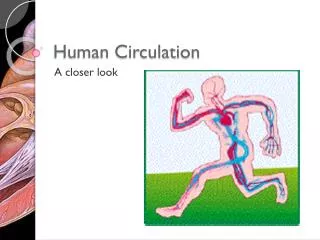
Human Circulation A closer look
Contents • Cardiac cycle • Maintenance of heartbeat • Principles governing blood circulation • Cardiovascular disease • Lymphatic system • Blood composition and function
Electrical activity of the heart 1 - Sinoatrial node (Pacemaker)2 - Atrioventricular node3 - Atrioventricular Bundle (Bundle of His)4 - Left & Right Bundle branches5 - Bundle Branches 6 - Purkinje fibers AV valves SL valves
Cardiac output • Total volume of blood pumped by the left ventricle per minute • Heart rate (HR) # beats per minute • Stroke volume (SV) mL • Product gives the cardiac output (Q) • Average adult Q = HR x SV = 70 beats/min x 75 mL/beat = 5.25 L/min • Maximum HR = 200-your age • Training heart rate is 75% MHR • e.g. 200-15 = 185 * 0.75 = 139 beats/min • 20 minutes, 3x a week
Pulse • Stretching of arteries as an effect of heartbeat • Pressure waves moving the artery walls when blood moves into aorta • Usually accurate measure of heart rate • Normal resting pulse is 60-100 bpm • Common pulse points 1. Temporal artery 3. Carotid artery 4. Brachial artery 5. Radial artery
Physical principles governing blood circulation • Blood flow velocity • Aorta (30 cm/s) • Capillaries (0.026 cm/s) • Law of continuity • Volume of flow per second must be constant through the entire pipe • Total cross-sectional area of the capillaries determines flow rate • Blood flow slows down in capillary beds
Osmotic pressure – amount of pressure required to prevent diffusion of water
Blood pressure • Force exerted by blood on walls of vessels • Pressure decreases from arteries to veins • Determined by cardiac output and peripheral resistance by arterioles • Arterial pressure measured by a sphygmomanometer • Systolic/Diastolic (mmHg) • Factors • Heart rate • Blood volume • Resistance of vessels • Viscosity
Lymphatic System • Functions • Returns excess body fluid to blood • Transports fats from intestines to blood • Defense • Anatomy • Lymph nodes scattered throughout body (thymus, spleen) • Vessels
Cardiovascular disease • Cardiovascular disease (>50% of all deaths) • Heart attack- death of cardiac tissue due to coronary blockage • Stroke- death of nervous tissue in brain due to arterial blockage • Atherosclerosis: arterial plaques deposit • Arteriosclerosis: plaque hardening by calcium deposits • Hypertension: high blood pressure • Hypercholesterolemia: LDL, HDL