Innovative Roller Coaster Design: From Concept to Final Testing
This report details the comprehensive design process of a revolutionary roller coaster by the Roller Coaster Design Group, featuring key members James Tomashot, Alex Styborski, Roberto Samaniego, and Peter Schaaf. The design includes exciting features such as double vertical loops, upward and downward horizontals, and bumps. We outline the brainstorming phases, initial and final design calculations, and testing results, achieving an impressive score of 103/100. Challenges like speed loss and horizontal loops were addressed, ensuring a thrilling ride experience.

Innovative Roller Coaster Design: From Concept to Final Testing
E N D
Presentation Transcript
Roller Coaster Design Group C: James Tomashot, Alex Styborski, Roberto Samaniego, Peter Schaaf
Overview • Brainstorming ideas • Initial paper design • Final design • Final test • Design problems and solutions
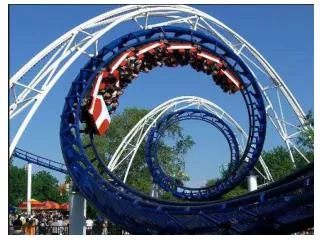
Brainstorming ideas • Double vertical loop • Upward horizontal that went through the double vertical loop • Downward horizontal • Bump • Straight away
Initial design feature list • Double vertical loop • Double horizontal downward • Turn in each direction • Bump • Straight Away • These features were all kept for the final design
Final design feature list • Double vertical loop • Double horizontal loop • Turns in both directions • Bump • Two straight away
Initial paper design calculations • (Insert table from IPD)
Initial paper design other calculations • Minimum velocity at the top of vertical loop #1: V = (gr)1/2 = (9.8*0.06m)1/2 = 0.7668 (m/s) • Actual velocity at the top of vertical loop #1: 2.1445 (m/s) • Minimum velocity at the top of vertical loop #2: V = (gr)1/2= (9.8*0.06m)1/2 = 0.7668 (m/s) • Actual velocity at the top of vertical loop #2: 1.138 (m/s) • Maximum velocity over the bump so no separation with track occurs: V = (gr)1/2 = (9.8*0.0508m)1/2
Final design calculations • (Insert table: in progress)
Final design other calculations • (in progress)
Final test • We received a 103/100 • All three test runs • The last two yielded the same results
Design Problems • Losing to much speed • Horizontal loops