
SlideServe
Menu
Préférences
© SlideServe · v2026

11.3

coy avatar
9 diapositives · 330 Views · Jul 25, 2014

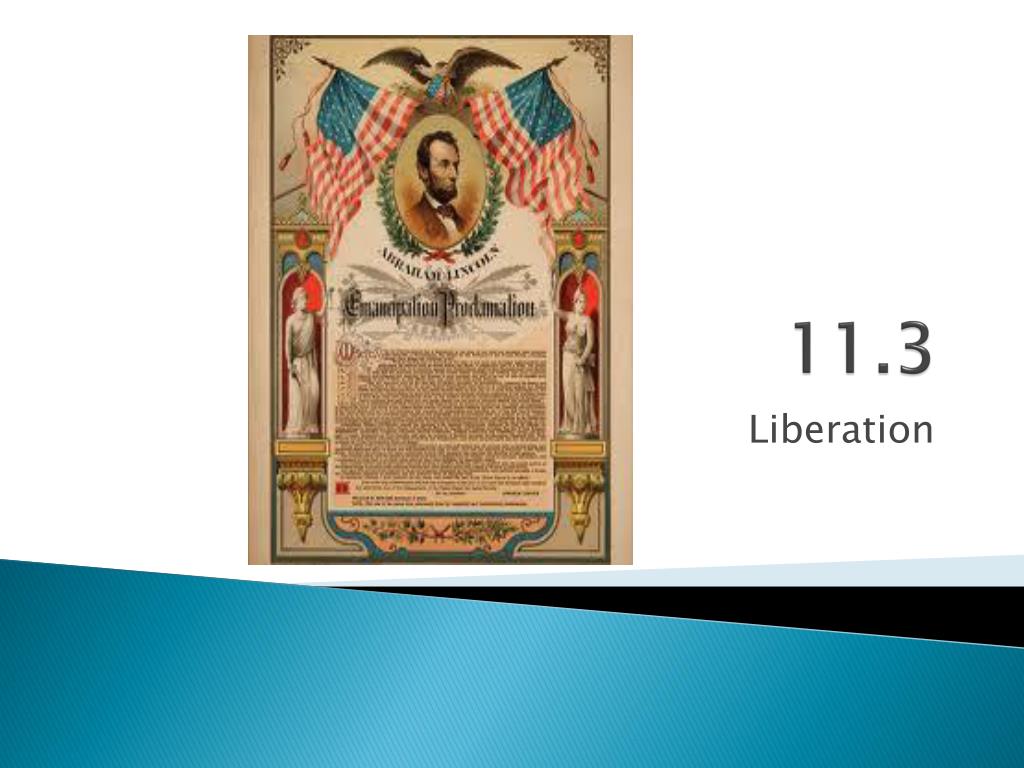
11.3. Liberation. The Preliminary Emancipation Proclamation. The initial Emancipation Proclamation stipulated that the South had 100 days to rejoin the Union before their slaves would be free If states did rejoin their slaves would remain in bondage
11.3 - slide 1
01 / 911.3
1 / 17

Télécharger la présentation

11.3
Une image / un lien ci-dessous est fourni (tel quel) pour télécharger la présentation

Politique de téléchargement : le contenu du site vous est fourni TEL QUEL pour votre information et votre usage personnel ; il ne peut être vendu, concédé sous licence ni partagé sur d’autres sites sans l’accord de son auteur.Le contenu vous est fourni TEL QUEL, pour votre information et votre usage personnel uniquement. Téléchargez la présentation en cliquant sur ce lien. Lors du téléchargement, si vous ne parvenez pas à télécharger une présentation, l’éditeur a peut-être supprimé le fichier de son serveur.Pendant le téléchargement, si vous ne parvenez pas à obtenir une présentation, le fichier a peut-être été supprimé par l’éditeur.

F I N

Plus de contenu associé

Transcription de la présentation
  1. 11.3 Liberation

  2. The Preliminary Emancipation Proclamation • The initial Emancipation Proclamation stipulated that the South had 100 days to rejoin the Union before their slaves would be free • If states did rejoin their slaves would remain in bondage • Lincoln waited till the Union victory at Antietam before issuing this statement • Southern whites ridiculed this proclamation and had no intention of rejoining the Union

  3. Northern Reaction to Emancipation • The north greeted the proclamation with little enthusiasm • Abolitionists were happy but many worried that slave states would return to the union before 1863 keeping slavery alive • Many white Northerners resented the proclamation, anti black riots were taking place in the north to protest competition with black workers

  4. Political Opposition to Emancipation • Northern Democrats opposed emancipation they feared competition with white workers • As a result democrats gained significant political power in elections • This showed the immense opposition to emancipation

  5. THE EMANCIPATION PROCLAMATION • On Jan. 1, 1863 Lincoln issued the Emancipation Proclamation freeing the slaves in the Confederate States • Despite much excitement from abolitionists and African Americans, the effects were limited • The Emancipation Proclamation only freed slaves in the South. It neglected to free the slaves in the border states of Kentucky, Delaware, Maryland and Missouri

  6. The Emancipation Proclamation • The proclamation was largely ignored in the South where Confederate leaders didn’t recognize Lincoln’s authority • They didn’t free their slaves but more slaves than ever attempted to free themselves • But, it did undermine slavery in the South and help lead to their eventual defeat

  7. Effects of the Proclamation in the South • The Proclamation guaranteed that foreign nations opposed to slavery would not recognize the Confederacy • Britain and France both took antislavery stances and thus could not support the Confederates • Slaves in the South became more likely to resist work on the plantations that might benefit the Confederate army • Lincoln also finally recognized that preserving the Union would require the end of slavery

  8. Assignment • 1. Why did Lincoln issue the Emancipation Proclamation? • 2. What were the limits of the Proclamation? • 3. How did Southern blacks react to the Proclamation? • 4. How did foreign nations respond to this statement? • 5. Describe the different reactions among northerners to the proclamation. Why were there such mixed emotions?