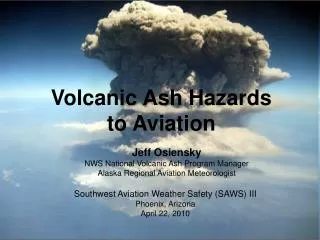
Volcanic Ash Hazards to Aviation
340 likes | 850 Vues
Volcanic Ash Hazards to Aviation. Jeff Osiensky NWS National Volcanic Ash Program Manager Alaska Regional Aviation Meteorologist.


Volcanic Ash Hazards to Aviation
E N D
Presentation Transcript
Volcanic Ash Hazards to Aviation Jeff Osiensky NWS National Volcanic Ash Program Manager Alaska Regional Aviation Meteorologist Southwest Aviation Weather Safety (SAWS) III Phoenix, Arizona April 22, 2010
Outline • Introduction to the ash hazard • Examples of eruptions • Potential damage/impacts • Why be concerned in the Southwest? Yellowstone and Long Valley Caldera! • Volcanic ash resources • Summary
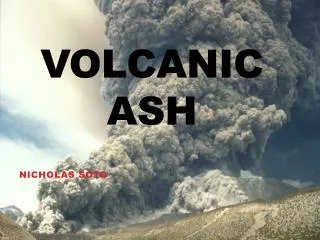
What is volcanic ash? • small tephra, which are bits of pulverized rock and glass created by volcanic eruptions Ash from Mt. St. Helens eruption May 18, 1980
Why is it a hazard to aviation? • Abrasive (can severely scratch airframe and windscreen) • clogs intakes and filter • restricts visibility • foul odor (in the presence of SO2) • glass will melt at high temps then solidify causing jet engine flameout
Examples of eruption • Fourpeaked Volcano, Alaska • Last erupted 10,000 years ago • Unexpected eruption on Sept. 17, 2006
Chaiten Volcano • Southern Chile May 2008 • Erupted unexpectedly after 9000+ years of dormancy
Long Valley Caldera • Caldera formed ~730k yrs ago • Many eruptions since • Most recent eruptions along • Mono and Inyo chain (last • ~550 years ago)
Super Volcanoes Long Valley and Yellowstone Super Volcanoes: ash production could cover 1/3 to 1/2 of U.S. or more
Who Does What… • Volcano Observatories • Provide information on the volcano itself (e.g. seismicity, behavior, etc.) • VAAC (Washington) • Run dispersion models, issue VAAs • MWO (AWC Kansas City) • Issue SIGMETs • CWSU/ARTCC • Issue CWAs and MISs, provide advice to ATMs
Web Resources • NOAA Air Resources Laboratory (HYSPLIT) http://ready.arl.noaa.gov/ready2-bin/ashhypo.pl • Aviation Weather Center (SIGMETs) http://aviationweather.gov/ • Washington Volcanic Ash Advisory Center http://www.ssd.noaa.gov/VAAC/washington.html • OFCM National Volcanic Ash Plan http://www.ofcm.gov/p35-nvaopa/pdf/FCM-P35-2007-NVAOPA.pdf • USGS Volcanoes Hazard Program http://volcanoes.usgs.gov/
Summary • Volcanic ash is a well documented hazard to aviation • Although historically active volcanic sources are thousands of miles away from the Southwest U.S….a Long Valley Caldera or Yellowstone event is a possibility • It is important to consider all weather and environmental risks that impact the aviation community
? ? Sarychev Peak June 2009
Thank You Jeff Osiensky National Weather Service Alaska Region Headquarters Anchorage, Alaska jeffrey.osiensky@noaa.gov 907.271.5132