SlideServe
Menu
Préférences
© SlideServe · v2026

c = -1 Perfect diamagnetism (Shielding of magnetic field) (Meissner effect)

cuthbert-nikolas avatar
19 diapositives · 454 Views · Nov 20, 2014

Dynamic variational principle and the phase diagram of high-temperature superconductors. c = -1 Perfect diamagnetism (Shielding of magnetic field) (Meissner effect). André-Marie Tremblay. k y. w. w. k x. k. r. -p/ a. p/ a. Some basic Solid State Physics : non-interacting electrons.
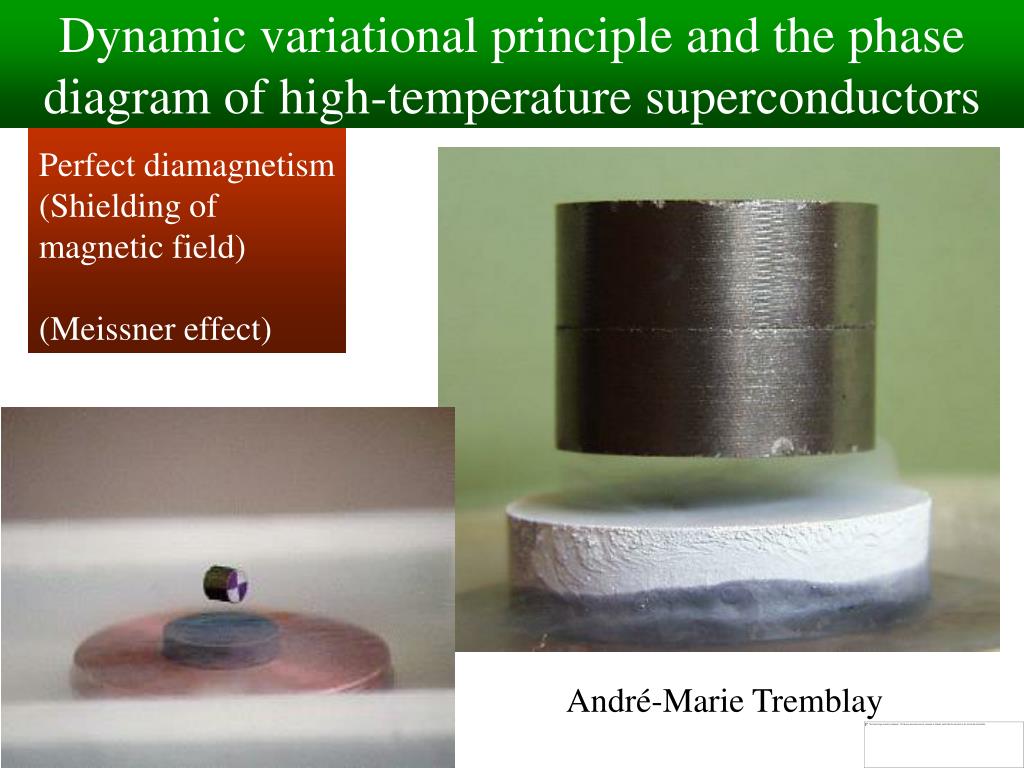
c = -1 Perfect diamagnetism (Shielding of magnetic field) (Meissner effect) - slide 1
01 / 19c = -1 Perfect diamagnetism (Shielding of magnetic field) (Meissner effect)
1 / 17

Télécharger la présentation

c = -1 Perfect diamagnetism (Shielding of magnetic field) (Meissner effect)
Une image / un lien ci-dessous est fourni (tel quel) pour télécharger la présentation

Politique de téléchargement : le contenu du site vous est fourni TEL QUEL pour votre information et votre usage personnel ; il ne peut être vendu, concédé sous licence ni partagé sur d’autres sites sans l’accord de son auteur.Le contenu vous est fourni TEL QUEL, pour votre information et votre usage personnel uniquement. Téléchargez la présentation en cliquant sur ce lien. Lors du téléchargement, si vous ne parvenez pas à télécharger une présentation, l’éditeur a peut-être supprimé le fichier de son serveur.Pendant le téléchargement, si vous ne parvenez pas à obtenir une présentation, le fichier a peut-être été supprimé par l’éditeur.

F I N

Plus de contenu associé

Transcription de la présentation
  1. Dynamic variational principle and the phase diagram of high-temperature superconductors c = -1 Perfect diamagnetism (Shielding of magnetic field) (Meissner effect) André-Marie Tremblay

  2. ky w w kx k r -p/a p/a Some basic Solid State Physics : non-interacting electrons

  3. e Photon 2 k = E +w + m- W ph 2m k Electronic states in d=2 Angle Resolved Photoemission Spectroscopy (ARPES)

  4. The non-interacting case EDC Damascelli, Shen, Hussain, RMP 75, 473 (2003)

  5. Electron-doped, non-interacting MDC

  6. Interacting case: The Fermi liquid A(k,w)f(w) Damascelli, Shen, Hussain, RMP 75, 473 (2003)

  7. A Fermi liquid ind = 2 T-TiTe2 U / W = 0.8 Perfetti, Grioni et al. Phys. Rev. B64, 115102(2001)

  8. w Q D k -p/a p/a Destroying the Fermi liquid at half-filling:Lattice + interactions A-Long-range order Introduce “frustration” Will “resist” LRO until critical U

  9. w w w U W W r r r U w w w W W U U DMFT- Georges, Kotliar, Rosenberg, 1986. r r r Destroying the Fermi liquid at half-filling:Lattice + interactions B-Strong on-site repulsion (Mott transition)

  10. Question: What happens away from n = 1? A- Long-Range Order (U large enough) Hole pockets: Still FL B- Mott transition : DMFT If gapped, gapped everywhere

  11. Two ways to destroy a Fermi liquid: hole and electron-doped cuprates. • I. Introduction • Fermi liquid • II. Experimental results from cuprates + model • III. Strong and weak coupling pseudogap (CPT) • IV. Weak coupling pseudogap (QMC,TPSC) • V. d-wave superconductivity • VI. Conclusion

  12. CuO2 planes YBa2Cu3O7-d

  13. Hole doping Electron doping Optimal doping Optimal doping Phase diagram n, electron density Damascelli, Shen, Hussain, RMP 75, 473 (2003)

  14. 15% 10% 10% 15% 4% Pseudogap at hot spots 4% Fermi surface, electron-doped case Armitage et al. PRL 87, 147003; 88, 257001

  15. Fermi surface, hole-doped case 10%

  16. Simplest microscopic model for Cu O planes. t’ t’’ m U LSCO t • Size of Hilbert space : • With N=16, It takes 4 GigaBits just to store the states (N = 16) The « Hubbard model »

  17. A(kF,w) A(kF,w) LHB UHB t Effective model, Heisenberg: J = 4t2 /U Weak vs strong coupling, n=1 T w U w U Mott transition U ~ 1.5W (W= 8t)

  18. Question: quantitative and qualitative • How do we go from a Mott insulator to a conductor as a function of doping? • Hot spots and pseudogaps in the Hubbard model (like experiment) ? • Close to understood in e-doped case.

  19. Two ways to destroy a Fermi liquid: hole and electron-doped cuprates. • I. Introduction • Fermi liquid • II. Experimental results from the cuprates and model • III. Strong and weak coupling pseudogap (CPT) • IV. Weak coupling pseudogap (QMC,TPSC) • V. d-wave superconductivity • VI. Conclusion