Geology
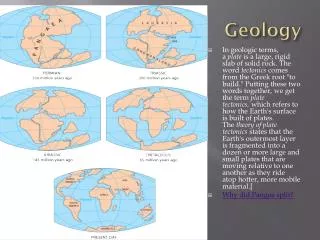
Geology, derived from the Greek word for Earth, is the scientific study of our planet's structure and composition. It divides Earth's interior into four main layers: the hot, solid inner core made of iron and nickel; the liquid outer core, slightly cooler; the mantle, the largest layer consisting of solid and liquid materials; and the crust, the cool outer shell on which we live. The crust is dynamic, with tectonic plates shifting over time. The concept of continental drift, exemplified by Pangaea, shows how Earth's landmasses have changed dramatically over millions of years.

Geology
E N D
Presentation Transcript
DEFINITION GEOLOGY Greek Earth The study of Geology = The study of Earth
INNER CORE • HOT!!!! – Thought to be as hot as the surface of the Sun! • Solid • Composed of Iron and Nickel
OUTER CORE • HOT! (but not as hot as the inner core) • Liquid • Composed of Iron and Nickel
MANTLE • Still hot! – but not as hot as the core! • Largest layer • Composed of various materials • Solid and liquid
CRUST • Cool • What we live on • Composed of rocks, various materials make up the crust • Solid or Liquid?
SOLID!!!! Even though 70% of the Earth’s surface is water, there is crust under the water. The water sits on top of the crust!
The Earth’s crust moves!!!!! • The continents have not always been arranged like they are today. - The Earth’s crust is divided into segments called plates.
Pangaea • Supercontinent that existed 250 million years ago • All the land made up 1 continent until its split into the modern day configuration of the continents. • Discovered by Alfred Wegner in 1912, but not accepted by the public until after his death in the 1950’s.