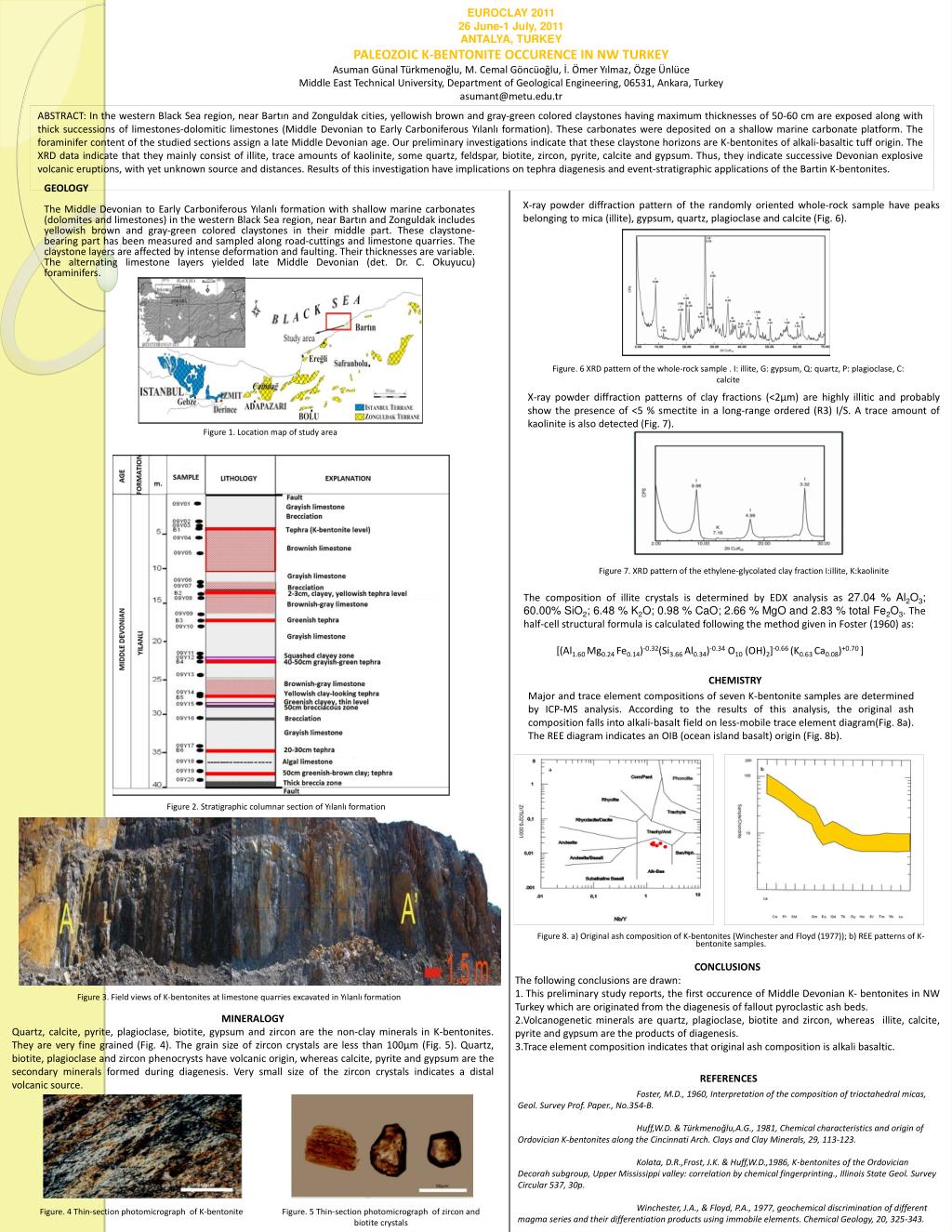
EUROCLAY 2011 26 June-1 July, 2011 ANTALYA, TURKEY PALEOZOIC K-BENTONITE OCCURENCE IN NW TURKEY Asuman Günal Türkmenoğlu, M. Cemal Göncüoğlu, İ. Ömer Yılmaz, Özge Ünlüce Middle East Technical University, Department of Geological Engineering, 06531, Ankara, Turkey asumant@metu.edu.tr ABSTRACT: In the western Black Sea region, near Bartın and Zonguldak cities, yellowish brown and gray-green colored claystones having maximum thicknesses of 50-60 cm are exposed along with thick successions of limestones-dolomitic limestones (Middle Devonian to Early Carboniferous Yılanlı formation). These carbonates were deposited on a shallow marine carbonate platform. The foraminifer content of the studied sections assign a late Middle Devonian age. Our preliminary investigations indicate that these claystone horizons are K-bentonites of alkali-basaltic tuff origin. The XRD data indicate that they mainly consist of illite, trace amounts of kaolinite, some quartz, feldspar, biotite, zircon, pyrite, calcite and gypsum. Thus, they indicate successive Devonian explosive volcanic eruptions, with yet unknown source and distances. Results of this investigation have implications on tephra diagenesis and event-stratigraphic applications of the Bartin K-bentonites. X-ray powder diffraction pattern of the randomly oriented whole-rock sample have peaks belonging to mica (illite), gypsum, quartz, plagioclase and calcite (Fig. 6). GEOLOGY The Middle Devonian to Early Carboniferous Yılanlı formation with shallow marine carbonates (dolomites and limestones) in the western Black Sea region, near Bartın and Zonguldak includes yellowish brown and gray-green colored claystones in their middle part. These claystone-bearing part has been measured and sampled along road-cuttings and limestone quarries. The claystone layers are affected by intense deformation and faulting. Their thicknesses are variable. The alternating limestone layers yielded late Middle Devonian (det. Dr. C. Okuyucu) foraminifers. Figure. 6 XRD pattern of the whole-rock sample . I: illite, G: gypsum, Q: quartz, P: plagioclase, C: calcite X-ray powder diffraction patterns of clay fractions (<2µm) are highly illitic and probably show the presence of <5 % smectite in a long-range ordered (R3) I/S. A trace amount of kaolinite is also detected (Fig. 7). Figure 1. Location map of study area Figure 7. XRD pattern of the ethylene-glycolated clay fraction I:illite, K:kaolinite The composition of illite crystals is determined by EDX analysis as 27.04 % Al2O3; 60.00% SiO2; 6.48 % K2O; 0.98 % CaO; 2.66 % MgO and 2.83 % total Fe2O3. The half-cell structural formula is calculated following the method given in Foster (1960) as: [(Al1.60 Mg0.24 Fe0.14)-0.32(Si3.66 Al0.34)-0.34 O10 (OH)2]-0.66 (K0.63 Ca0.08)+0.70 ] CHEMISTRY Major and trace element compositions of seven K-bentonite samples are determined by ICP-MS analysis. According to the results of this analysis, the original ash composition falls into alkali-basalt field on less-mobile trace element diagram(Fig. 8a). The REE diagram indicates an OIB (ocean island basalt) origin (Fig. 8b). Figure 2. Stratigraphic columnar section of Yılanlı formation Figure 8. a) Original ash composition of K-bentonites (Winchester and Floyd (1977)); b) REE patterns of K-bentonite samples. • CONCLUSIONS • The following conclusions are drawn: • This preliminary study reports, the first occurence of Middle Devonian K- bentonites in NW Turkey which are originated from the diagenesis of fallout pyroclastic ash beds. • Volcanogenetic minerals are quartz, plagioclase, biotite and zircon, whereas illite, calcite, pyrite and gypsum are the products of diagenesis. • Trace element composition indicates that original ash composition is alkali basaltic. Figure 3. Field views of K-bentonites at limestone quarries excavated in Yılanlı formation MINERALOGY Quartz, calcite, pyrite, plagioclase, biotite, gypsum and zircon are the non-clay minerals in K-bentonites. They are very fine grained (Fig. 4). The grain size of zircon crystals are less than 100µm (Fig. 5). Quartz, biotite, plagioclase and zircon phenocrysts have volcanic origin, whereas calcite, pyrite and gypsum are the secondary minerals formed during diagenesis. Very small size of the zircon crystals indicates a distal volcanic source. REFERENCES Foster, M.D., 1960, Interpretation of the composition of trioctahedral micas, Geol. Survey Prof. Paper., No.354-B. Huff,W.D. & Türkmenoğlu,A.G., 1981, Chemical characteristics and origin of Ordovician K-bentonites along the Cincinnati Arch. Clays and Clay Minerals, 29, 113-123. Kolata, D.R.,Frost, J.K. & Huff,W.D.,1986, K-bentonites of the Ordovician Decorah subgroup, Upper Mississippi valley: correlation by chemical fingerprinting., Illinois State Geol. Survey Circular 537, 30p. Winchester, J.A., & Floyd, P.A., 1977, geochemical discrimination of different magma series and their differentiation products using immobile elements. Chemical Geology, 20, 325-343. Figure. 4 Thin-section photomicrograph of K-bentonite Figure. 5 Thin-section photomicrograph of zircon and biotite crystals